

 English
 русский
 Español
 عربى

No. 8, Duxiu San Road, Ganlin Town, Shengzhou City, Shaoxing City, Zhejiang Province, China

News Category
Product Category
YS100L1-8 380V 400W Low-Speed Motor for Cattle House Fans
Content
- 1 Product Overview
- 2 Why Low-Speed Operation Matters in Cattle Houses
- 3 Stable Airflow for Livestock Environments
- 4 Three-Phase Asynchronous Motor Design
- 5 Eight-Pole Construction and Performance Advantages
- 6 400W Power Rating for Ventilation Applications
- 7 Energy Efficiency and Long-Term Operating Value
- 8 IP55 Protection for Agricultural Working Conditions
- 9 Class F Insulation and Thermal Reliability
- 10 Advantages Compared with Generic Competitor Motors
- 11 Manufacturing Strengths of the Supplier
- 12 Production Process and Quality Control Considerations
- 13 Integration with Cattle House Fan Systems
- 14 Installation and Commissioning Guidance
- 15 Maintenance for Long Operating Life
- 16 Application Areas Beyond Cattle Houses
- 17 Ordering and Technical Confirmation Checklist
- 18 Frequently Asked Questions
- 18.1 What is the YS100L1-8 motor designed for?
- 18.2 What are the main electrical specifications?
- 18.3 Why is an eight-pole motor suitable for cattle house ventilation?
- 18.4 Is this motor suitable for continuous operation?
- 18.5 What does IP55 mean for this motor?
- 18.6 What is the benefit of Class F insulation?
- 18.7 Can the motor be used with a variable-frequency drive?
- 18.8 Can this motor replace another cattle house fan motor?
- 18.9 What information should be provided for a customized motor?
- 18.10 Where is the manufacturer located?
- 18.11 How should the motor be maintained?
- 19 Why Choose This Motor for a Ventilation Project?
- 20 Conclusion
- 21 References
- 22 Product: YS100L1-8 380V 50Hz 400W Cattle House Fan Motor
Reliable ventilation is essential in modern cattle houses. Livestock buildings require continuous air movement to control heat, humidity, odors, airborne particles, and the accumulation of harmful gases. A suitable fan motor must therefore do more than rotate a blade. It must provide stable operation for long periods, maintain consistent airflow, withstand dusty agricultural environments, and operate with reasonable energy consumption and noise levels.
The YS100L1-8 380V 400W cattle house fan motor is designed for this type of demanding application. It is a dedicated low-speed three-phase asynchronous motor intended for large cattle house ventilation fans. Its eight-pole configuration supports smooth, steady rotation, while the 380V supply specification makes it appropriate for many industrial and agricultural three-phase power systems. With IP55 protection and Class F insulation, the motor is structured for dependable service in working environments where dust, moisture, temperature variation, and long operating cycles are common.
Manufactured by Shengzhou Jiangxin Motor Technology Co., Ltd., the motor reflects the company’s focus on AC/DC motors, micro motors, ventilation equipment motors, and customized motor solutions. The company combines modern production facilities, automated manufacturing equipment, professional research and development capabilities, and systematic quality control. These strengths support the production of motors intended for stable performance rather than short-term or intermittent use.
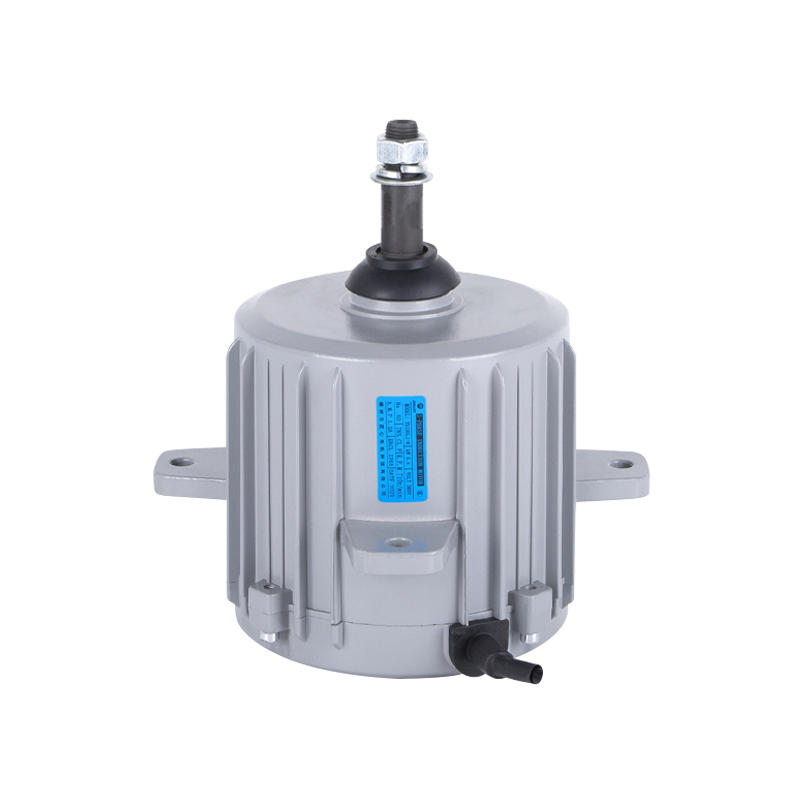
YS100L1-8 380V 50Hz 400W Cattle House Fan Motor
Product Overview
The YS100L1-8 is a 400W low-speed cattle house fan motor with a rated voltage of 380V. The supplied product information identifies the motor as a three-phase asynchronous design for cattle house ventilation equipment. Its eight-pole structure is particularly important because it produces a lower rotational speed than comparable motors with fewer poles when operated at the same frequency.
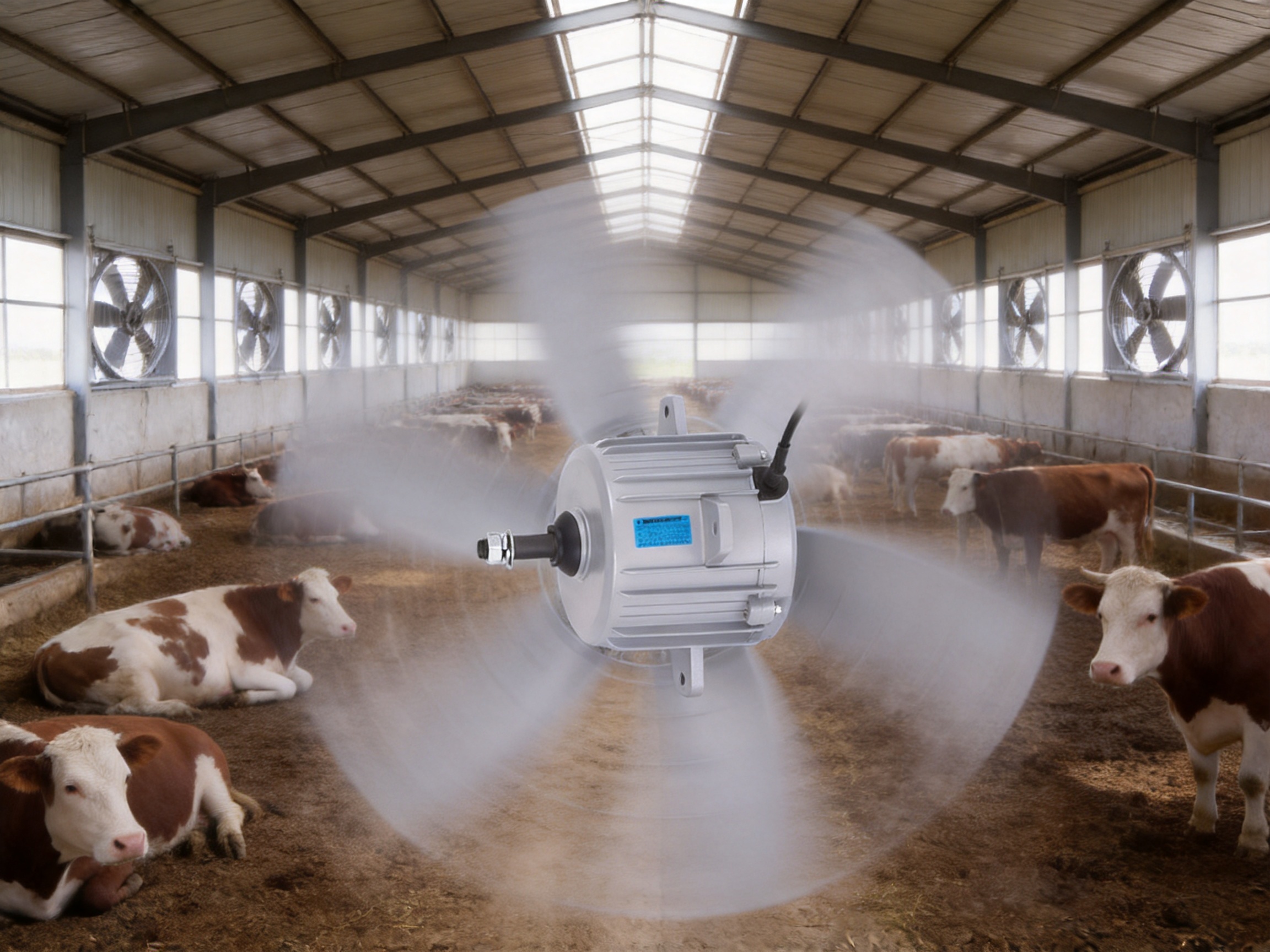
Large livestock fans generally do not require the high rotational speed associated with small domestic fans. Instead, they need a broad and stable airflow pattern across a large area. Excessively high fan speed may create strong local drafts, increase noise, raise vibration, and make airflow less comfortable for animals. A low-speed motor allows the fan system to move air in a more controlled way, helping support a balanced cattle house climate.
The principal product specifications are summarized below.
| Item | Specification |
|---|---|
| Product type | Cattle house fan motor |
| Model | YS100L1-8 |
| Rated voltage | 380V |
| Rated power | 400W |
| Frequency | 50/60Hz information supplied; confirm the required operating frequency before ordering |
| Motor construction | Three-phase asynchronous motor |
| Number of poles | 8 poles |
| Protection rating | IP55 |
| Insulation class | Class F |
| Primary application | Large cattle house and livestock ventilation fans |
The product title specifies 380V, 50Hz, while the supplied information table lists 50/60Hz. Customers should confirm the exact frequency, nameplate requirements, starting method, mounting dimensions, shaft details, and other installation data with the manufacturer before placing a production order. These details may vary according to the intended fan assembly and regional electrical standards.
Why Low-Speed Operation Matters in Cattle Houses
Ventilation in a cattle house must balance several conditions at the same time. Air must move sufficiently to remove heat and humidity, but the airflow should not be so aggressive that it causes discomfort. Fans must also run for extended periods without excessive electrical consumption, mechanical stress, or maintenance demand.
An eight-pole motor is naturally suited to low-speed operation. Motor speed is related to the supply frequency and the number of poles. At 50Hz, an eight-pole motor has a synchronous speed of approximately 750 revolutions per minute, while the actual operating speed is slightly lower because of slip. The exact running speed depends on load, design, voltage, frequency, and operating conditions. At 60Hz, the theoretical synchronous speed is higher, so the final fan speed must be evaluated for the actual power supply and fan design.
Compared with a higher-speed motor connected to a reduction system, an eight-pole motor may provide a more direct solution for applications requiring naturally lower rotational speed. A direct or simplified drive arrangement can reduce the number of transmission components, depending on the fan structure. Fewer transmission components may help reduce alignment problems, belt-related maintenance, and mechanical losses. The final system design must still be checked by the fan manufacturer or installation engineer.
Stable low-speed rotation is also helpful for large-diameter fan blades. Large blades can produce substantial airflow without needing high rotational speed. When the motor maintains consistent rotation, the fan can provide a more uniform air distribution across the cattle house. This is valuable in buildings where animals are distributed over a wide area and where stagnant zones may otherwise develop.
Stable Airflow for Livestock Environments
Cattle are sensitive to heat stress, especially when ambient temperatures and humidity rise. Proper ventilation can assist with heat removal and improve the overall environment in the building. Air movement can also help reduce moisture accumulation and support more consistent conditions around feeding, resting, and walking areas.
The YS100L1-8 is designed for fan systems that prioritize continuous and stable air circulation. Its low-speed configuration is suitable for ventilation layouts where the objective is not a concentrated blast of air, but broad movement across the building. The motor can therefore form part of a ventilation strategy that uses multiple fans, controlled operating schedules, or staged airflow according to seasonal conditions.
Ventilation performance depends on more than motor power. Blade diameter, blade pitch, fan guard design, housing structure, installation height, air inlet arrangement, building layout, and local climate all influence the final airflow. The motor provides the mechanical input, but the complete fan system must be correctly matched to the building and livestock requirements.
When properly matched, a 400W motor can support an energy-conscious ventilation arrangement for applications that do not require a larger motor rating. Selecting an appropriately sized motor is important. An undersized motor may operate near overload, while an unnecessarily oversized motor can increase equipment cost and energy use. The 400W rating provides a practical option for certain cattle house fan designs, subject to fan load and manufacturer verification.
Three-Phase Asynchronous Motor Design
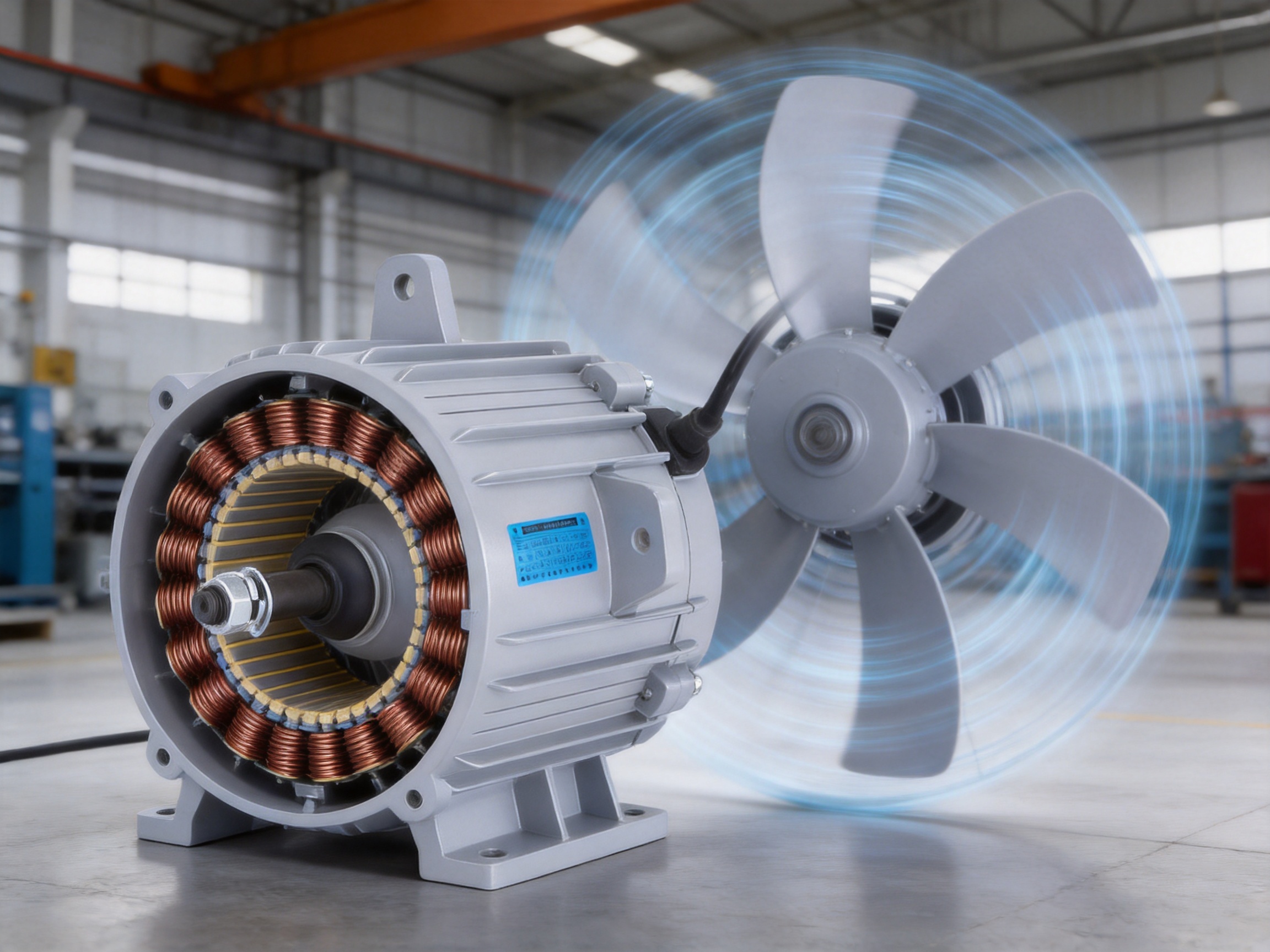
The YS100L1-8 uses a three-phase asynchronous motor configuration. Three-phase motors are widely used in industrial and agricultural installations because they can provide smooth torque production and reliable continuous operation. In comparison with many single-phase arrangements, a three-phase motor can be well suited to larger equipment and fixed installations where an industrial power supply is available.
Asynchronous motors operate through the interaction between the rotating magnetic field produced by the stator and the rotor. The rotor turns at a speed slightly lower than the synchronous magnetic-field speed. This difference, known as slip, enables torque to be developed. The design is mechanically robust and does not require brushes or a commutator, which can reduce certain wear-related maintenance requirements compared with brushed motor technologies.
For cattle house fans, this type of construction offers several practical benefits. The motor can be integrated into a fixed ventilation system, operated for long periods, and serviced through standard industrial maintenance procedures. The absence of brush replacement is also useful in installations where many fans are distributed throughout a large building or farm site.
The motor’s actual current, starting characteristics, torque curve, and permissible operating conditions should be confirmed from the final technical data sheet. These values are important when selecting contactors, overload protection, cables, circuit breakers, variable-frequency drives, and control panels.
Eight-Pole Construction and Performance Advantages
The eight-pole arrangement is one of the most important characteristics of this model. A higher pole count generally results in a lower synchronous speed at a given frequency. This allows the motor to produce the speed range required by large ventilation fans without depending exclusively on external speed reduction.
Compared with a generic high-speed motor, the eight-pole design can offer several application-related advantages:
First, it supports smooth and controlled fan rotation. This is suitable for buildings where airflow must be spread over a broad area rather than delivered as a narrow, high-velocity stream.
Second, it can reduce the likelihood of excessive fan noise caused by unnecessarily high blade speed. Noise depends on the complete fan assembly, but motor speed is an important factor in acoustic performance.
Third, lower rotational speed may help limit mechanical stress on the fan blade assembly, bearings, and mounting structure. The exact effect depends on blade diameter, balance, inertia, and operating load.
Fourth, an eight-pole motor can simplify the selection of a motor-to-fan speed relationship. In some systems, a motor with a naturally appropriate speed may reduce the need for complicated transmission arrangements.
Finally, low-speed operation is consistent with the gradual, continuous air movement often required for livestock housing. This makes the model more application-specific than a general-purpose motor selected without considering fan speed.
400W Power Rating for Ventilation Applications
The rated power of the YS100L1-8 is 400W. This rating indicates the motor’s nominal mechanical output capacity under specified operating conditions. It should not be interpreted as a universal fan capacity because the actual air volume and static pressure depend on the fan design and installation environment.
A 400W motor can be advantageous where the ventilation system requires moderate power and long operating duration. In continuous-use agricultural equipment, even small differences in power consumption may become meaningful over an entire season. A correctly matched motor can support dependable airflow without unnecessarily increasing the electrical load.
Motor selection should consider the complete operating point. The fan may encounter different loads during startup and normal operation. Dust accumulation, bearing condition, belt tension, air resistance, and changing building pressure can also affect the required torque. The motor should not be operated beyond its rated capacity, and suitable overload protection should be installed.
Where a variable-frequency drive is considered, the user should verify compatibility with the motor insulation system, cooling performance, low-frequency torque requirements, and control range. Frequency control may be helpful for seasonal airflow adjustment, but it should be applied in accordance with the motor and drive manufacturer’s instructions.
Energy Efficiency and Long-Term Operating Value
Energy saving is a major concern for cattle house ventilation because fans may run for many hours each day. The product description highlights an optimized copper winding design intended to reduce power consumption and operating temperature while supporting continuous running.
Copper windings contribute to efficient electrical conduction and help manage resistive losses. Lower winding losses can reduce heat generation inside the motor, although overall motor temperature is also influenced by ventilation, ambient temperature, load, voltage balance, installation, and enclosure conditions.
Energy performance should always be evaluated using verified test data for the final motor configuration. Nevertheless, a motor designed specifically for low-speed fan duty has an important advantage over an unsuitable general-purpose motor. Its electrical and mechanical characteristics can be selected around the requirements of continuous ventilation rather than occasional operation.
Efficient operation also depends on system maintenance. A clean fan guard, correctly tensioned belt, balanced blade, unobstructed air inlet, and properly lubricated bearing system can help the motor operate closer to its intended load. Poor fan maintenance may increase torque demand and cause the motor to draw more current, regardless of its original efficiency.
IP55 Protection for Agricultural Working Conditions
The YS100L1-8 is specified with an IP55 protection rating. In the Ingress Protection classification, the first digit indicates protection against solid particles, while the second digit relates to water protection. IP55 generally indicates protection against harmful dust deposits and protection against water jets from different directions.
This level of protection is valuable in cattle house applications because agricultural buildings may contain dust, feed particles, fibers, and airborne contaminants. Cleaning activities may also expose equipment to water spray. IP55 does not mean that the motor is waterproof or suitable for immersion. It should not be installed where it will be submerged, exposed to uncontrolled high-pressure cleaning, or subjected to conditions beyond its design rating.
Correct installation remains essential. Cable glands, terminal boxes, covers, mounting interfaces, and shaft seals must be properly fitted to preserve the intended protection level. Damaged seals or loosely installed cable entries can reduce environmental protection even when the motor itself has been manufactured to IP55 requirements.
Regular inspection can help preserve performance. Operators should check for dust accumulation, moisture marks, corrosion, loose fasteners, unusual vibration, and deterioration of cables. Any cleaning procedure should follow the motor manufacturer’s recommendations.
Class F Insulation and Thermal Reliability
The motor is specified with Class F insulation. Insulation class defines the thermal capability of the motor winding insulation system. Class F is commonly associated with a higher allowable thermal capability than Class B, although the actual permissible temperature rise depends on the motor design, test method, ambient conditions, and applicable standards.
For a cattle house fan, thermal reliability is important because operation may continue through hot weather and long duty cycles. A motor that experiences excessive heat can suffer accelerated insulation aging, reduced service life, and increased risk of electrical failure. Class F insulation provides a useful design margin when properly matched with the motor’s temperature rise and operating environment.
Insulation class should not be regarded as permission to operate the motor under overload. Thermal protection, correct voltage, phase balance, proper ventilation, and suitable installation are still necessary. If the motor is installed in a high-temperature area, the user should confirm any required derating or special cooling provisions.
Advantages Compared with Generic Competitor Motors
Many motors can rotate a fan, but not all motors are equally appropriate for a large livestock ventilation system. The main advantage of the YS100L1-8 is its application-oriented combination of low speed, moderate power, three-phase construction, environmental protection, and insulation capability.
Compared with a generic two-pole or four-pole motor, the eight-pole configuration is better aligned with low-speed fan duty. A higher-speed motor may require additional pulleys, belts, gear reduction, or electronic control to reach the desired fan speed. Those additional components may increase system complexity and create more points that require inspection.
Compared with a lightly protected indoor motor, the IP55 enclosure is better suited to dusty and occasionally wet agricultural surroundings. It still requires correct installation, but it offers a stronger baseline for environmental resistance.
Compared with a motor intended only for short intermittent operation, a model designed for stable, long-hour ventilation is more suitable for the operating pattern of cattle house fans. Continuous ventilation places sustained thermal and mechanical demands on the motor, so duty suitability is an important selection criterion.
Compared with an oversized motor, the 400W rating may provide a more economical option when matched with the actual fan load. Avoiding excessive motor capacity can help reduce purchase cost and unnecessary electricity consumption. However, the motor must not be selected solely by power rating; fan torque, starting load, and pressure conditions must also be reviewed.
Compared with motors supplied without application support, a manufacturer with experience in AC/DC motors, micro motors, ventilation equipment, and customized products can provide more useful technical communication during project development. This is particularly important for OEM fan manufacturers and agricultural equipment distributors that require consistent specifications across multiple production batches.
Manufacturing Strengths of the Supplier
Shengzhou Jiangxin Motor Technology Co., Ltd. was established in 2017 and specializes in the research, development, production, and sales of AC/DC motors and micro motors. Its product range includes evaporative air cooler motors, industrial heater motors, oil pump motors, customized motors, and other application-focused products.
The company operates from Shengzhou, Zhejiang, a region supported by the industrial resources and supply-chain infrastructure of the Yangtze River Delta. This location can assist access to component suppliers, manufacturing services, engineering resources, and logistics networks. For international buyers, a developed industrial environment can support more consistent procurement and production coordination.
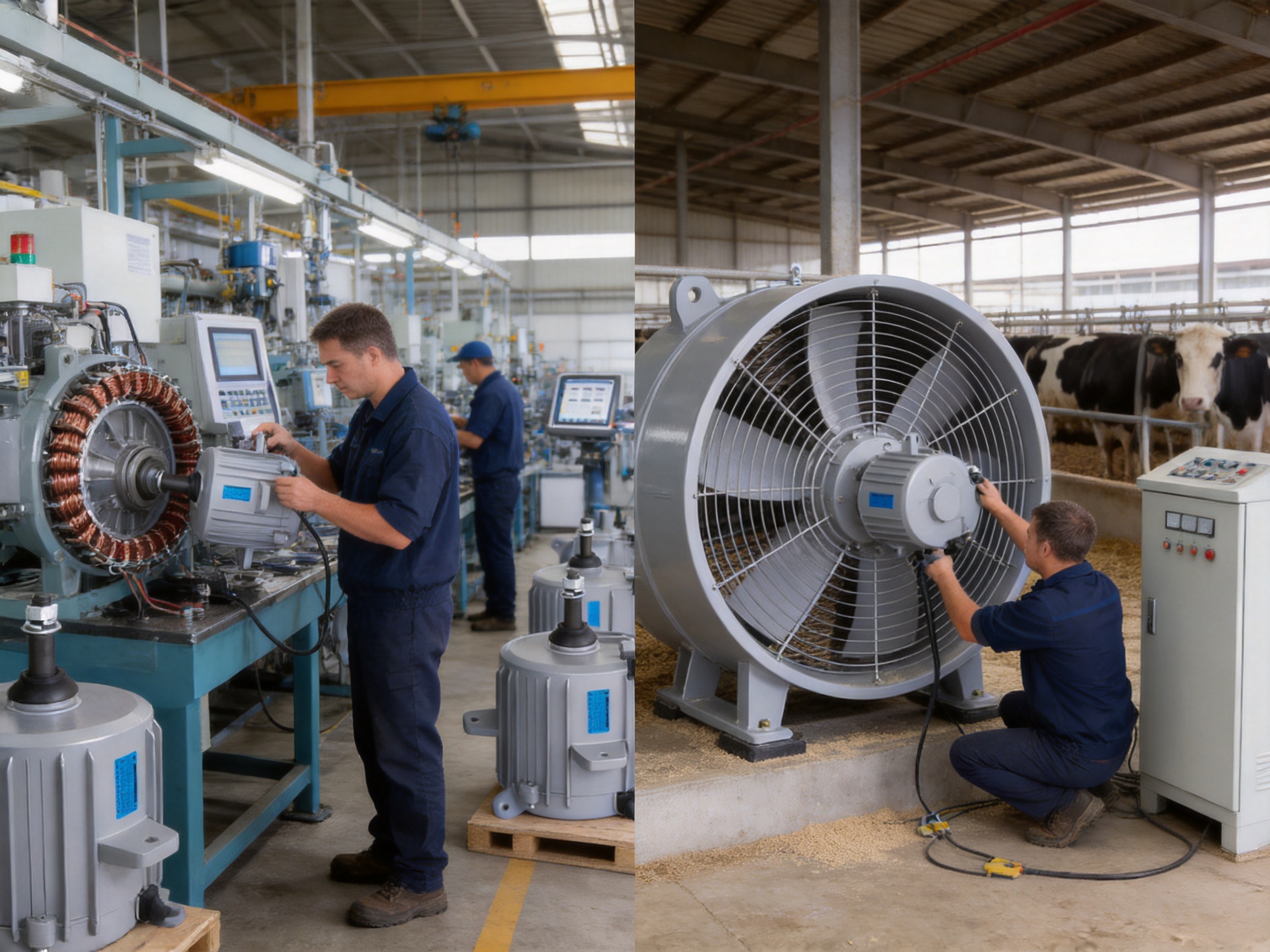
The company reports that it owns modern production facilities and advanced automated equipment. Automation can improve repeatability in processes such as component handling, winding, assembly, and inspection when properly controlled. Consistent process parameters are important for motor production because variations in winding placement, connection quality, bearing installation, or rotor-stator alignment may influence electrical and mechanical performance.
A professional R&D team supports product development and customization. This capability is valuable when a customer requires changes to voltage, frequency, shaft configuration, mounting arrangement, lead length, connector type, protection structure, or fan integration. Any customization should be reviewed through formal drawings and technical confirmation before production.
The company has also been recognized as a provincial-level technology enterprise. Its stated quality-control systems and innovation capabilities are intended to support reliable, energy-efficient, and durable motor products. The company reports exports to more than 60 countries and regions, indicating experience in serving overseas customers and adapting products to different application markets.
Production Process and Quality Control Considerations
Although exact factory process parameters are not provided in the supplied product information, a professional motor manufacturing process generally depends on controlled operations across the entire production chain. For a low-speed three-phase motor, quality begins with the selection and verification of electrical steel, copper wire, insulation materials, bearings, rotor components, housing parts, fasteners, and protective elements.
Stator preparation is a key stage. Laminated steel components must be correctly assembled, and winding operations must place the specified copper wire accurately in the stator slots. Winding tension, wire routing, insulation separation, lead connections, and impregnation or securing methods can all influence reliability.
Rotor assembly requires attention to balance, shaft alignment, bearing seats, and the air gap between rotor and stator. Proper alignment helps reduce vibration and mechanical noise. In a fan application, this is especially important because the motor is connected to a rotating blade assembly that may amplify imbalance.
Assembly quality also affects environmental protection. Terminal box covers, gaskets, cable entries, and enclosure interfaces must be fitted correctly to support the IP55 rating. The motor’s external finish should be appropriate for the intended environment, and fasteners should be tightened according to controlled procedures.
Electrical testing may include winding resistance checks, insulation resistance testing, dielectric strength testing, no-load operation, current measurement, and verification of rotation. Mechanical checks may include vibration, noise, bearing condition, shaft runout, and visual inspection. The exact tests depend on the production standard, customer specification, and final motor design.
Modern automated equipment can help improve process consistency, but automation must be supported by trained personnel, calibrated instruments, documented procedures, and traceable inspection records. The combination of equipment, engineering, and quality management is more important than any individual machine.
Integration with Cattle House Fan Systems
The motor is one component within a complete ventilation system. Before installation, the fan designer or installer should confirm that the motor’s rated speed, power, torque, shaft dimensions, mounting arrangement, and direction of rotation match the fan assembly.
The fan blade must be balanced, and the motor should be installed on a rigid, level support. Misalignment can increase vibration and bearing load. If belts are used, pulley alignment and belt tension should be checked carefully. Excessive belt tension may overload bearings, while insufficient tension may cause slipping and heat generation.
The electrical installation should be performed by qualified personnel. The supply voltage, frequency, phase sequence, grounding, cable size, overload protection, and disconnecting device should be selected according to the motor nameplate and local electrical requirements. The motor should not be connected to a power supply that has not been verified for voltage and frequency compatibility.
For systems using several fans, control logic may stage fans according to temperature, humidity, carbon dioxide concentration, time schedule, or other environmental measurements. The motor can therefore be used as part of a larger automated ventilation system, provided that the control equipment is compatible with the motor and designed for agricultural service.
Installation and Commissioning Guidance
Before installation, inspect the motor for transport damage. Confirm that the housing, terminal box, shaft, mounting feet, cable entries, and protective surfaces are intact. Rotate the shaft manually where appropriate to identify abnormal resistance or mechanical damage. Do not energize a motor that shows visible defects or signs of moisture inside the terminal area.
Check the nameplate against the intended supply. The available information identifies 380V and provides frequency information for 50/60Hz, while the product title specifies 50Hz. This difference should be resolved before commissioning. Voltage and frequency affect speed, current, torque, heating, and fan performance.
Confirm the phase sequence and rotation direction during initial testing. If the fan rotates in the wrong direction, disconnect the power and correct the phase connection according to qualified electrical procedures. Never attempt to correct rotation while the motor is energized.
Start the motor without unnecessary mechanical obstruction and observe current, sound, vibration, and acceleration. After the fan reaches operating speed, check for blade interference, excessive vibration, unusual bearing noise, loose fasteners, and abnormal heating. Record baseline operating data for future maintenance comparison.
Protective devices should be tested before the fan is placed into routine service. The overload setting must be compatible with the motor’s rated current, and the grounding connection must be secure. Where multiple fans are installed, each motor should be individually identifiable for inspection and troubleshooting.
Maintenance for Long Operating Life
Preventive maintenance helps preserve the efficiency and reliability of cattle house fan motors. Inspection intervals should be adapted to operating hours, dust level, humidity, cleaning methods, and the manufacturer’s instructions.
Operators should regularly inspect the external housing, fan guard, mounting frame, shaft area, cable glands, and terminal box. Dust or debris should be removed using an approved method that does not force contaminants through seals or damage the enclosure. High-pressure water should not be directed at the motor unless the complete system has been specifically designed for that cleaning procedure.
Listen for changes in sound. A new humming, grinding, rattling, or cyclic noise may indicate bearing wear, loose hardware, blade imbalance, belt problems, or electrical issues. Vibration should also be monitored because it may increase gradually before a visible failure occurs.
Check the fan blades for dirt buildup and physical damage. Accumulated material can unbalance the fan and increase motor load. Inspect belts and pulleys where used, and correct alignment or tension problems promptly. A clean and mechanically efficient fan enables the motor to operate closer to its intended design point.
Electrical connections should be checked for looseness, discoloration, overheating, or corrosion by qualified personnel. Phase imbalance and low voltage can increase motor heating. If the motor repeatedly trips an overload device, the cause should be investigated rather than simply increasing the protection setting.
Application Areas Beyond Cattle Houses
The primary application is cattle house ventilation, but the same operating characteristics may suit other large agricultural or industrial ventilation systems. Potential applications include livestock barns, agricultural storage areas, greenhouse ventilation, workshops, equipment rooms, and other buildings requiring steady low-speed air circulation.
Suitability depends on the complete fan assembly and environmental conditions. The product should not automatically be used in hazardous locations, explosive atmospheres, immersion conditions, corrosive chemical environments, or extreme temperatures without written confirmation from the manufacturer.
For OEM customers, the motor may be incorporated into a standardized fan product. The company’s experience with customized motors can support discussions about mechanical interfaces, electrical connections, packaging, labeling, and production quantities. Customers should provide complete technical drawings and operating requirements when requesting a customized configuration.
Ordering and Technical Confirmation Checklist
Before ordering the YS100L1-8, customers should confirm the following information with the supplier:
1. Required voltage and whether the system uses 380V three-phase power.
2. Required frequency, especially because the supplied materials reference both 50Hz and 50/60Hz.
3. Rated power and the calculated fan load at startup and normal operation.
4. Motor speed and fan speed required for the selected blade and ventilation system.
5. Mounting dimensions, shaft diameter, shaft extension, keyway, and installation orientation.
6. Terminal box position, cable length, connector type, and rotation direction.
7. Required control method, including direct-on-line starting or variable-frequency operation.
8. Ambient temperature, humidity, dust level, cleaning method, and installation altitude.
9. Required documents, including drawings, test reports, inspection records, packaging details, and nameplate information.
10. Quantity, delivery schedule, warranty terms, spare parts, and after-sales technical support.
Clear technical confirmation reduces the risk of mismatch between the motor and fan. It also allows the manufacturer to identify whether a standard model is suitable or whether a customized version is needed.
Frequently Asked Questions
What is the YS100L1-8 motor designed for?
It is designed as a low-speed three-phase asynchronous motor for cattle house fans and similar ventilation equipment. Its eight-pole construction is intended to provide stable rotation for large-area air circulation.
What are the main electrical specifications?
The supplied information identifies a 380V voltage rating and 400W power rating. The product title specifies 50Hz, while the specification table lists 50/60Hz. The exact operating frequency should be confirmed with the manufacturer before purchase.
Why is an eight-pole motor suitable for cattle house ventilation?
An eight-pole motor provides a lower natural speed than motors with fewer poles at the same supply frequency. This is suitable for large fans that need broad, steady airflow rather than high-speed, concentrated drafts.
Is this motor suitable for continuous operation?
The product is described as being engineered for stable, long-hour ventilation and continuous running. Actual duty suitability depends on the final fan load, ambient temperature, electrical supply, installation, and maintenance. The nameplate and technical data should be reviewed before commissioning.
What does IP55 mean for this motor?
IP55 generally indicates protection against harmful dust deposits and water jets from different directions. It does not mean the motor can be submerged or exposed to uncontrolled high-pressure washing. Cable entries, covers, and seals must be installed correctly.
What is the benefit of Class F insulation?
Class F insulation provides a thermal capability commonly used for industrial motor windings. It can support reliable operation under demanding conditions when the motor is correctly loaded and cooled. It does not allow operation beyond the rated electrical and thermal limits.
Can the motor be used with a variable-frequency drive?
Potentially, but compatibility must be confirmed. The motor insulation system, cooling behavior, control range, low-frequency load, and drive settings should be evaluated by qualified technical personnel and approved by the manufacturer.
Can this motor replace another cattle house fan motor?
Replacement depends on more than voltage and power. The replacement motor must match speed, torque, mounting dimensions, shaft details, rotation, electrical connections, protection requirements, and fan load. A technical comparison should be completed before substitution.
What information should be provided for a customized motor?
Customers should provide voltage, frequency, power, speed, phase type, mounting dimensions, shaft configuration, terminal requirements, duty cycle, ambient conditions, protection rating, insulation class, control method, and expected order quantity. Fan drawings and load information are also useful.
Where is the manufacturer located?
Shengzhou Jiangxin Motor Technology Co., Ltd. is located at No. 8, Duxiu San Road, Ganlin Town, Shengzhou City, Shaoxing City, Zhejiang Province, China. The company provides AC/DC motors, micro motors, ventilation-related motors, and customized motor solutions.
How should the motor be maintained?
Maintenance should include inspection of dust, moisture, vibration, noise, mounting fasteners, fan balance, belts, electrical connections, and overload protection. Cleaning and electrical work should follow safe procedures and the manufacturer’s instructions.
Why Choose This Motor for a Ventilation Project?
The YS100L1-8 provides a focused combination of characteristics for cattle house fan applications. Its 400W output is appropriate for selected moderate-load ventilation systems, its 380V three-phase configuration fits many industrial power networks, and its eight-pole design supports low-speed airflow. IP55 protection and Class F insulation further strengthen its suitability for demanding agricultural service.
Its strongest advantage is application matching. Instead of treating the motor as a generic rotating component, the design emphasizes stable low-speed operation, long-hour ventilation, energy-conscious winding design, and environmental durability. These characteristics can help fan manufacturers, agricultural equipment integrators, and farm operators select a motor that corresponds more closely to real operating conditions.
The supplier’s manufacturing resources add value for customers who require repeatable production, technical support, and possible customization. Modern facilities, automated equipment, R&D capability, quality-control systems, and international market experience provide a foundation for serving both standard product buyers and OEM projects.
Final performance will always depend on the complete ventilation system. Correct fan matching, electrical protection, installation quality, environmental control, and regular maintenance are essential. When these factors are properly managed, the YS100L1-8 can serve as a dependable power source for continuous cattle house ventilation and other low-speed industrial fan applications.
Conclusion
The YS100L1-8 380V 400W cattle house fan motor is a specialized low-speed motor for stable livestock ventilation. Its eight-pole three-phase asynchronous construction is suited to large fans that require broad, controlled airflow. The 400W rating provides a practical option for appropriately matched fan loads, while the optimized copper winding concept supports energy-conscious operation and reduced operating temperature.
IP55 protection improves resistance to dust and water jets, and Class F insulation supports thermal reliability in long-hour service. These features give the motor a practical advantage over generic motors that may not be designed for agricultural ventilation conditions.
Supported by Shengzhou Jiangxin Motor Technology Co., Ltd.’s production facilities, automated equipment, R&D resources, and quality-control approach, the motor is suitable for customers seeking a stable standard product or a foundation for a customized ventilation solution. Before purchase and installation, buyers should confirm frequency, speed, dimensions, current, fan load, control method, and all nameplate requirements.
References
1. Product specification information supplied for the YS100L1-8 cattle house fan motor.
2. Manufacturer company profile and technical capability information supplied by Shengzhou Jiangxin Motor Technology Co., Ltd.
3. General principles of three-phase asynchronous motor operation and pole-related synchronous speed.
4. General guidance on IP protection classifications for electrical enclosures.
5. General guidance on motor insulation classes, thermal operation, installation, and preventive maintenance.
Product: YS100L1-8 380V 50Hz 400W Cattle House Fan Motor
Related Products
-
YS100L1-8 380V 50Hz 400W Cattle House Fan Motor
-
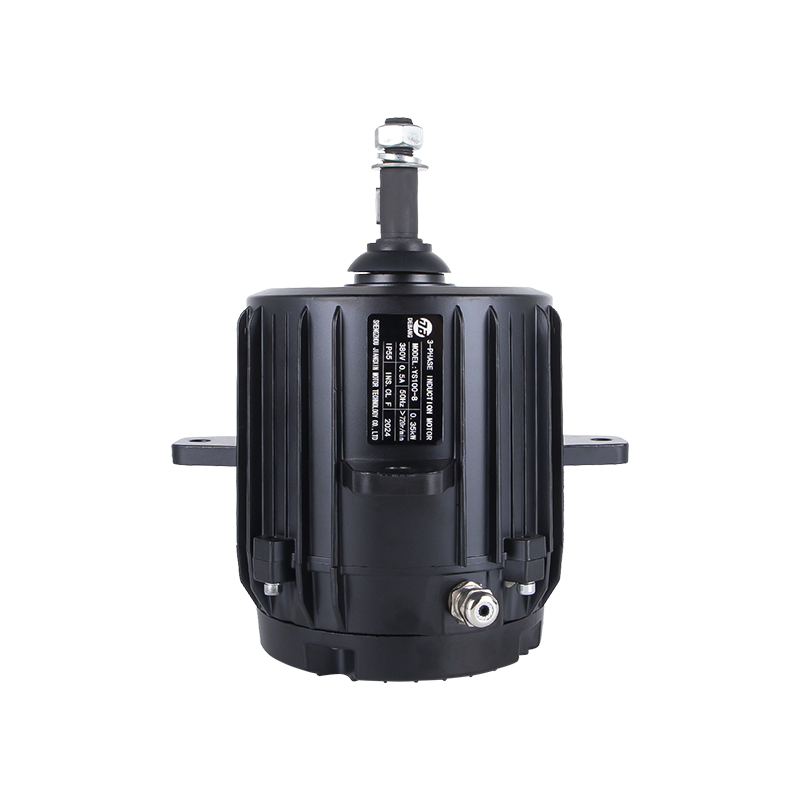 YS100-8 380V 50Hz 350W Cattle House Fan Motor
-
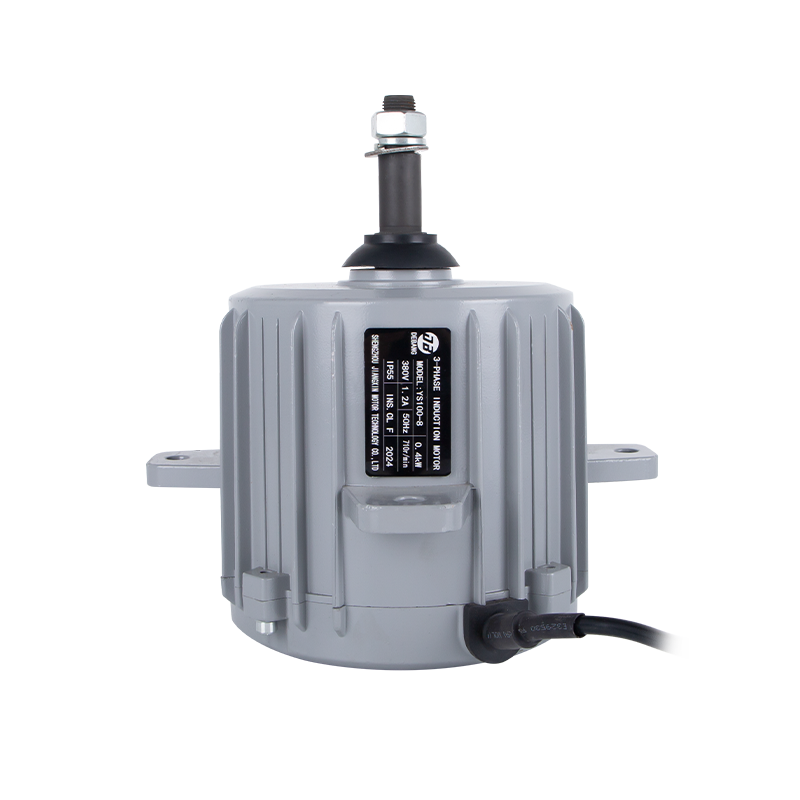 YS100-8 380V 50Hz 350W Cattle House Fan Motor
-
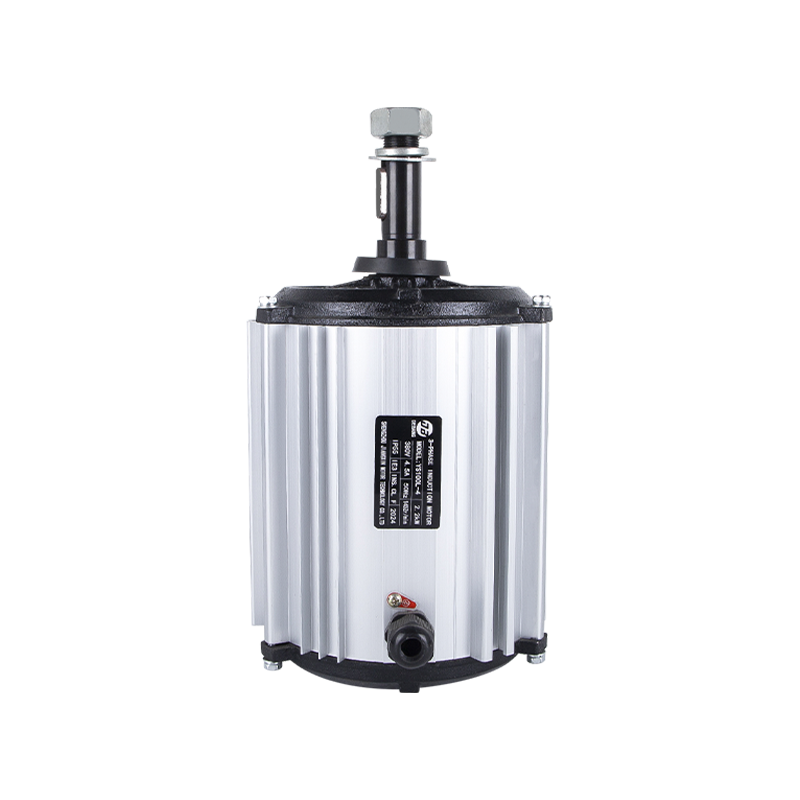 YS100L-4 380V 2200W 3-Phase Evaporative Air Cooler Motor
-
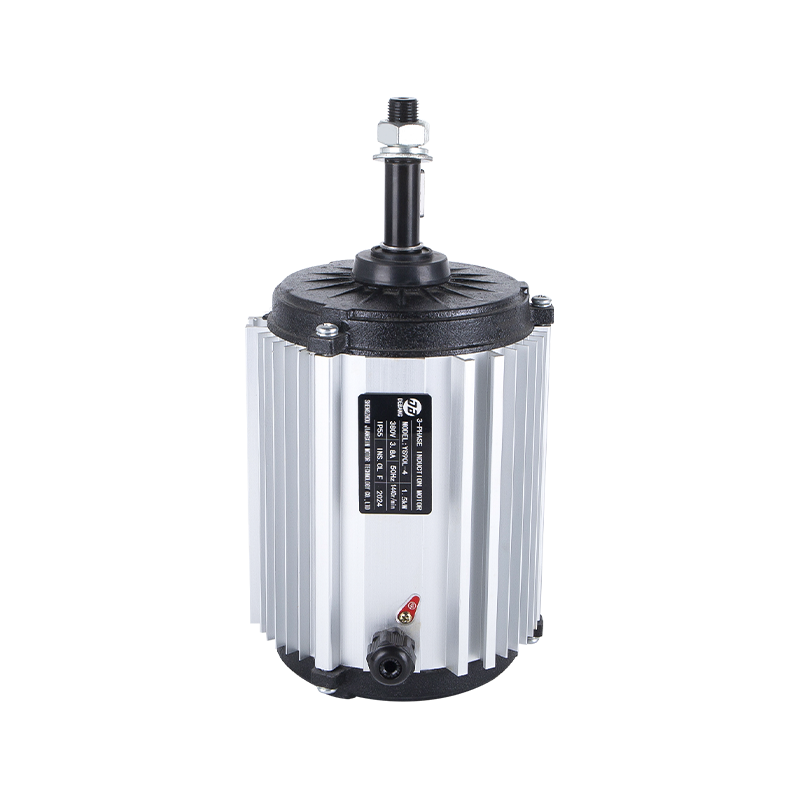 YS90L-4 380V 1500W 3-Phase Evaporative Air Cooler Motor
-
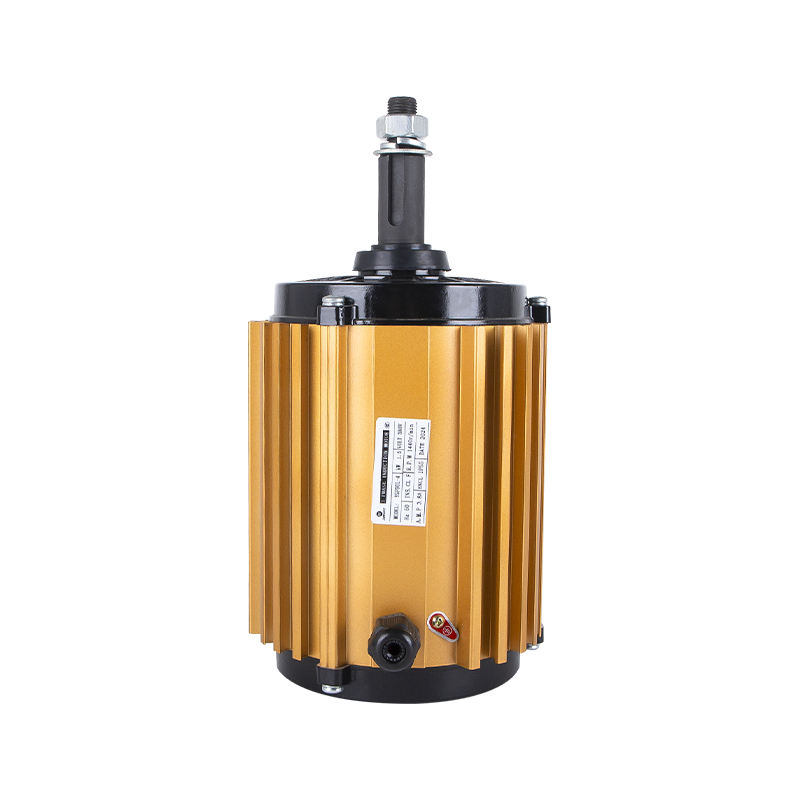 YS90L-4 380V 1500W 3-Phase Evaporative Air Cooler Motor
 Ready To Customise
Your Motor Products?

We are professional motor manufacturers, delivering powerful, stable, and efficient power cores for all industries through precision craftsmanship and innovation.
Contact Us
-
 Mobile:+86 13575536911
-
 Tel:+86 18357538240
-
 Whatsapp:+8618357538240
-
 Email:betty@dbjxmotor.com
-
 Company Address
Copyright © by Shengzhou Jiangxin Motor Technology Co., Ltd. All Rights Reserved.
Wholesale Industrial Fan Motors Manufacturers
