

 English
 русский
 Español
 عربى
عربى
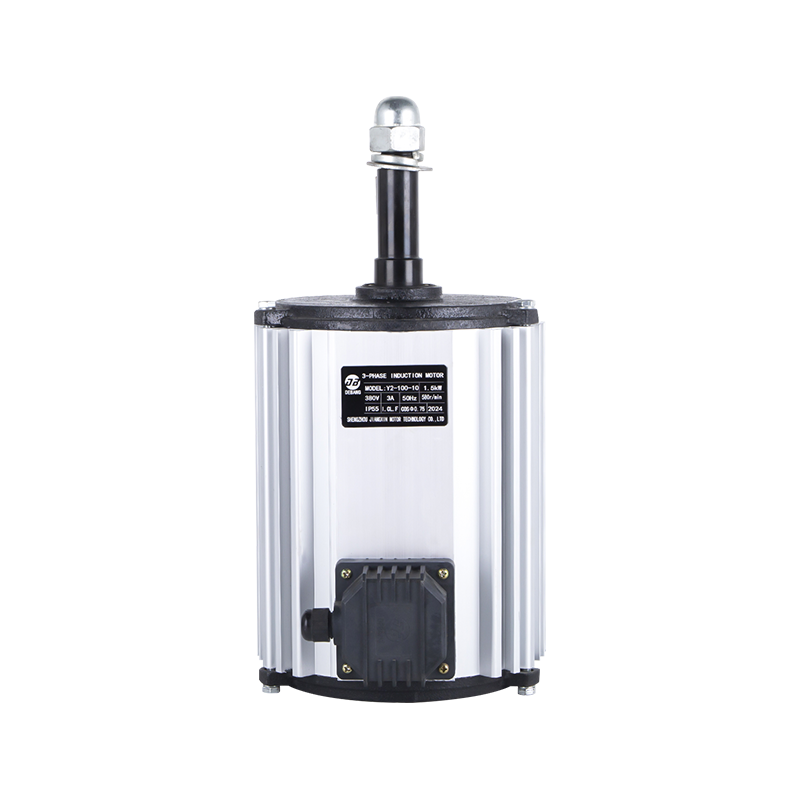
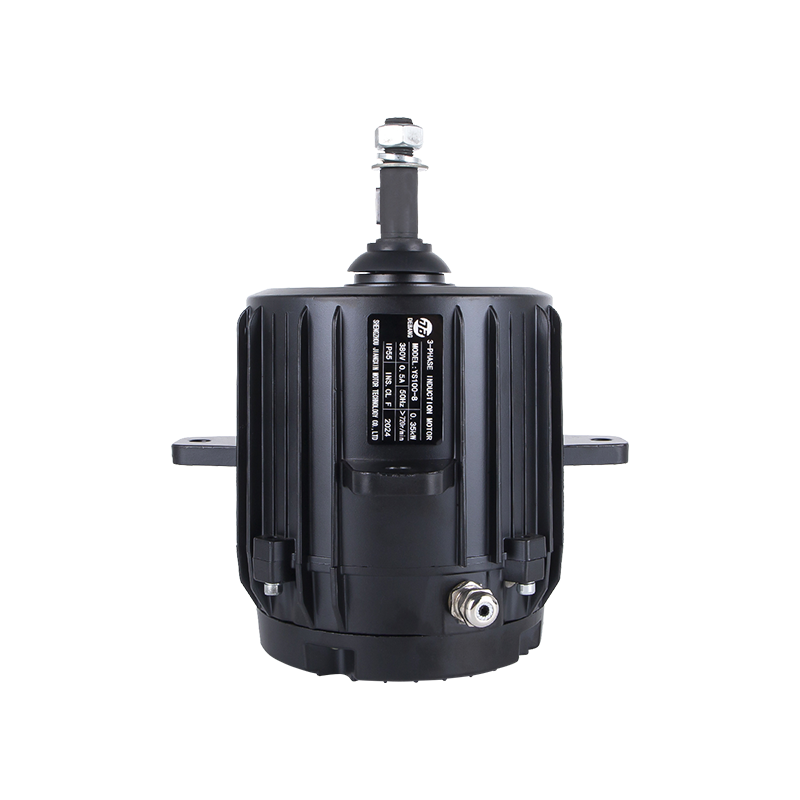
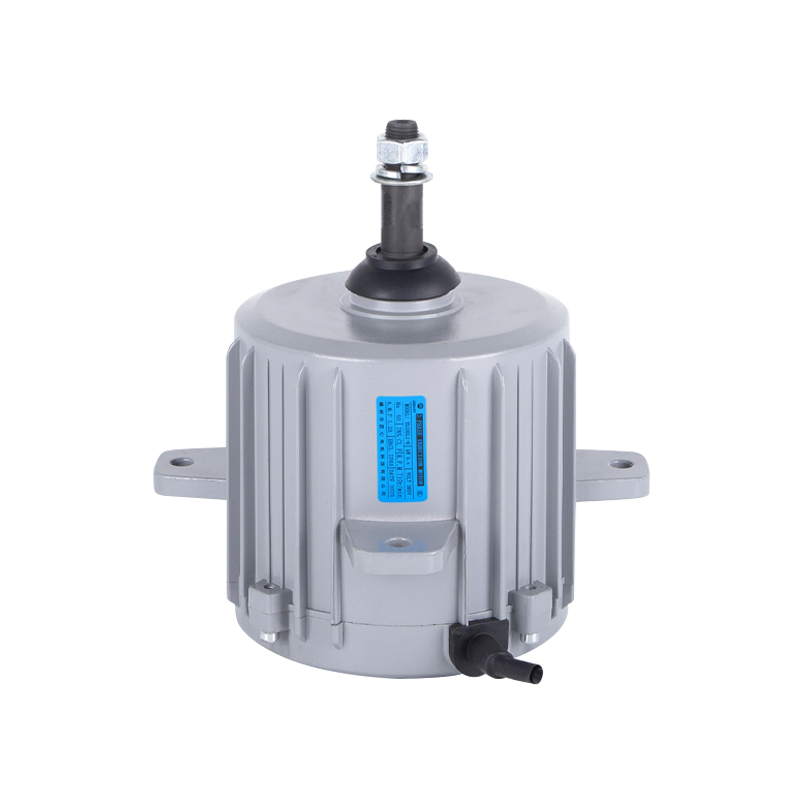
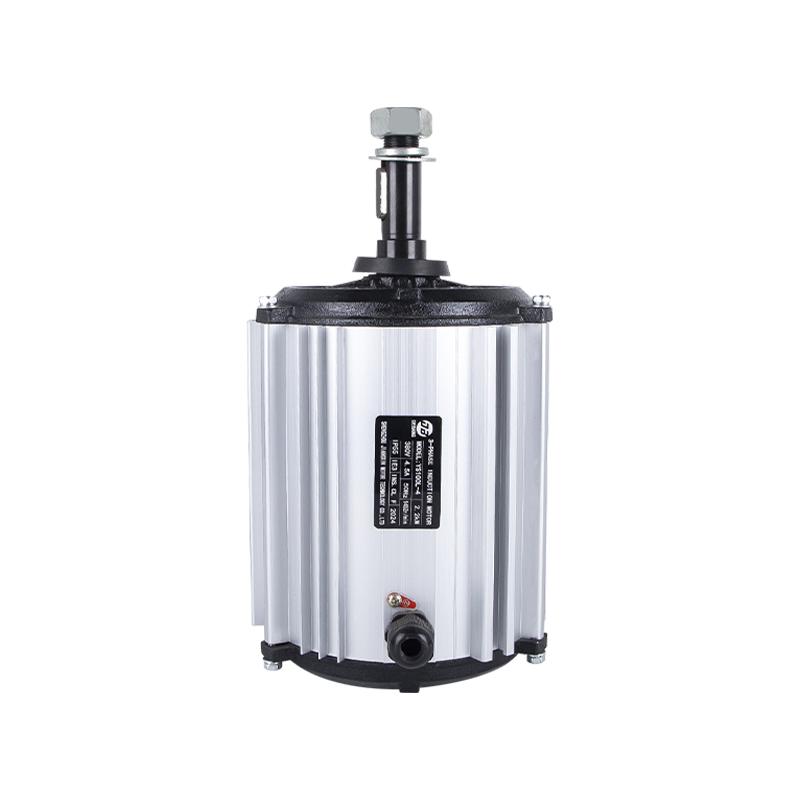
No. 8, Duxiu San Road, Ganlin Town, Shengzhou City, Shaoxing City, Zhejiang Province, China

News Category
Product Category
Y2-100-10 380V 1100W Fiber Glass Fan Motor: Reliable Corrosion-Resistant Power for Industrial Ventilation
Content
- 1 1. Product Overview
- 2 2. Why the Motor Housing Matters in Difficult Environments
- 3 3. Electrical and Mechanical Operating Characteristics
- 4 4. Competitive Advantages Compared with Conventional Fan Motors
- 5 5. Manufacturing Strengths and Production Capabilities
- 6 6. Manufacturing Process Considerations
- 7 7. Applications Across Multiple Industries
- 8 8. Installation Guidelines
- 9 9. Maintenance and Service Practices
- 10 10. How to Select the Correct Motor for a Fiberglass Fan
- 11 11. Purchasing Advantages for Distributors and OEM Customers
- 12 12. Energy, Reliability, and Total Cost Considerations
- 13 13. Quality and Reliability Strengths of the Manufacturer
- 14 14. Recommended Use Cases and Limitations
- 15 15. Frequently Asked Questions
- 15.1 Q1: What type of motor is the Y2-100-10?
- 15.2 Q2: What environments are suitable for this motor?
- 15.3 Q3: Why choose fiberglass instead of cast iron?
- 15.4 Q4: Is the motor suitable for every fiberglass fan?
- 15.5 Q5: What does the 10-pole design indicate?
- 15.6 Q6: Can the motor operate on a single-phase supply?
- 15.7 Q7: Does fiberglass make the motor waterproof?
- 15.8 Q8: What protection should be used during installation?
- 15.9 Q9: What industries can use this product?
- 15.10 Q10: What manufacturing strengths support this motor?
- 15.11 Q11: Can customized versions be requested?
- 15.12 Q12: What should be checked before placing an order?
- 16 16. Conclusion
- 17 References
- 18 Product: Y2-100-10 380V 1100W Fiber Glass Fan Motor
Industrial ventilation systems operate in environments where ordinary motors may suffer from corrosion, moisture, dust, chemical exposure, and demanding operating schedules. Fiberglass fans are widely selected for agricultural buildings, livestock facilities, chemical workshops, coastal installations, and other locations where corrosion resistance is essential. However, the performance of a fiberglass fan depends not only on the fan blades and housing. The motor must also deliver stable power, dependable rotation, efficient heat management, and long service life under challenging conditions.
The Y2-100-10 380V 1100W Fiber Glass Fan Motor is a three-phase asynchronous motor developed for fiberglass fan applications. With a rated supply of 380V, a power output of 1100W, and a 10-pole configuration, it is designed to provide reliable mechanical power for industrial and agricultural ventilation equipment. Its fiberglass motor casing offers a practical advantage over conventional metal housings in humid, corrosive, acidic, alkaline, and coastal environments.
This product combines a corrosion-resistant exterior, a relatively lightweight structure, straightforward installation, and compatibility with fiberglass ventilation systems. It is manufactured by Shengzhou Jiangxin Motor Technology Co., Ltd., a specialized motor producer established in 2017 in Shengzhou, Zhejiang Province, China. The company focuses on AC motors, DC motors, micro motors, evaporative air cooler motors, industrial heater motors, oil pump motors, and customized motor solutions.
The purpose of this article is to examine the product’s construction, operating characteristics, application value, competitive advantages, manufacturing strengths, quality considerations, installation requirements, maintenance practices, and selection guidelines. The discussion is intended for equipment manufacturers, distributors, agricultural ventilation contractors, industrial users, and purchasing teams seeking a suitable motor for fiberglass fans.
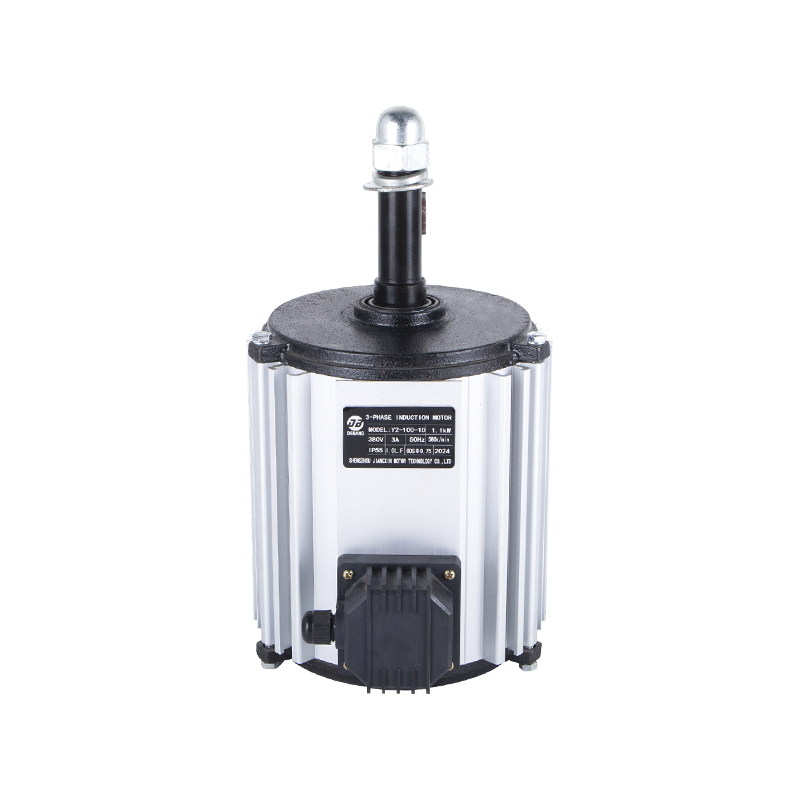
Y2-100-10 380V 1100W Fiber Glass Fan Motor
1. Product Overview
The Y2-100-10 380V 1100W Fiber Glass Fan Motor is a three-phase asynchronous motor specially designed for use with fiberglass fans. Its electrical rating is 380V and 1100W, and its 10-pole design is intended for applications that require dependable, relatively low-speed operation and steady torque characteristics.
Three-phase asynchronous motors are widely used in industrial equipment because they have a practical structure, stable operating behavior, and no brushes or mechanical commutators that require regular replacement. The squirrel-cage induction principle enables the motor to operate reliably in many demanding environments when it is correctly selected, installed, protected, and maintained.
The motor’s fiberglass casing is one of its most important distinguishing features. Unlike a conventional cast-iron or standard steel housing, fiberglass provides strong resistance to rust and many common forms of environmental degradation. This makes the motor especially suitable for applications where air may contain moisture, fertilizer particles, salt, acidic vapors, alkaline compounds, or other corrosive substances.
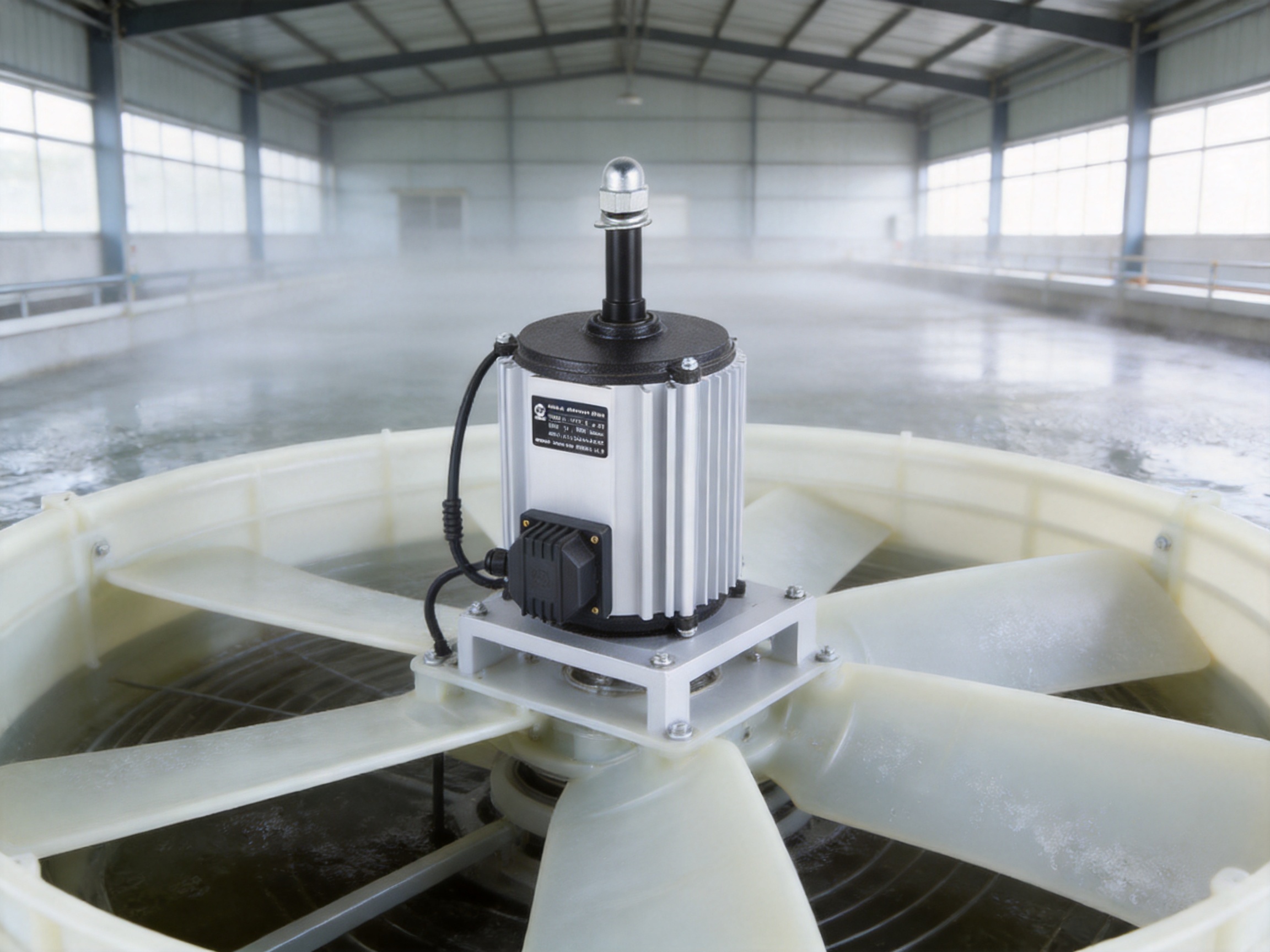
The motor is intended to work with fiberglass fans and related ventilation systems. Its relatively lightweight housing can simplify handling during installation, replacement, and maintenance. This is particularly useful when motors are installed on elevated fan assemblies, external wall fans, livestock ventilation systems, or large air-moving equipment that must be serviced in confined spaces.
| Item | Specification or Characteristic | Application Significance |
|---|---|---|
| Product type | Fiber glass fan motor | Designed for fiberglass fan and ventilation equipment |
| Motor principle | Three-phase asynchronous motor | Provides stable industrial operation with a robust structure |
| Rated voltage | 380V | Suitable for compatible three-phase industrial power systems |
| Rated power | 1100W | Provides mechanical output for medium-duty fan applications |
| Number of poles | 10 poles | Supports a lower-speed operating profile and steady fan drive |
| Housing material | Fiberglass | Resists rust and improves suitability for corrosive environments |
| Frequency | 50Hz | Designed around common industrial power conditions |
| Primary use | Fiberglass fans and industrial ventilation | Suitable for agricultural, chemical, coastal, and humid sites |
2. Why the Motor Housing Matters in Difficult Environments
Motor housing selection is often underestimated when ventilation equipment is specified. The housing protects internal electrical and mechanical components from environmental exposure, supports the motor’s mechanical structure, and influences installation weight and long-term maintenance requirements. In a clean indoor workshop, a conventional metal housing may be sufficient. In a livestock building, fertilizer facility, coastal warehouse, or chemical processing area, the choice of housing can have a significant effect on operating life.
2.1 Resistance to Rust
Metal surfaces can gradually oxidize when they are exposed to water, condensation, salt, manure gases, cleaning chemicals, or high humidity. Surface corrosion may begin as a cosmetic issue, but it can eventually affect mounting points, fasteners, cooling surfaces, cable entries, and structural strength. Rust can also make future disassembly difficult and increase the time required for maintenance.
The fiberglass housing of the Y2-100-10 motor is naturally suited to situations where rust prevention is a priority. Because fiberglass does not rust in the same way as steel or cast iron, the housing can retain a cleaner and more stable external surface in damp or corrosive installations. This characteristic is particularly valuable for fans installed in agricultural buildings, where persistent humidity and airborne contaminants are common.
2.2 Resistance to Acids and Alkalis
Some ventilation systems operate near chemical storage areas, industrial cleaning processes, fertilizer handling facilities, wastewater equipment, or livestock housing. Airborne acidic or alkaline substances may attack exposed metal components over time. A fiberglass enclosure can offer a stronger defense against these conditions than ordinary unprotected metal surfaces.
Environmental compatibility must always be assessed according to the actual chemicals, concentration, temperature, exposure duration, and cleaning procedures at the installation site. Fiberglass is not automatically suitable for every chemical environment. Nevertheless, its resistance to many common corrosive conditions gives the motor a valuable advantage when compared with conventional housings that are not specifically protected against chemical exposure.
2.3 Resistance to Aging
Ventilation equipment is often expected to operate for long periods with limited interruption. Outdoor installations and agricultural facilities may expose motors to sunlight, moisture, temperature variation, dust, and repeated cleaning. Materials that deteriorate quickly can lead to cracks, surface failure, or reduced protection for internal components.
The fiberglass casing is designed to provide good resistance to aging, helping the motor remain suitable for extended service in demanding operating conditions. Proper installation remains essential. The motor should be protected from direct mechanical damage, excessive heat, prolonged immersion, and conditions beyond its rated design. When used within an appropriate operating environment, the housing material can reduce the maintenance burden associated with external corrosion and deterioration.
2.4 Reduced Handling Weight
Fiberglass is generally lighter than cast iron. This can make a practical difference during transportation, mounting, replacement, and routine inspection. Fan motors are frequently installed at height or in locations where access is limited. A lighter motor can reduce the physical effort required from installers and may simplify the design of brackets and supporting structures, provided that the support system is correctly engineered.
Lower weight does not mean that the motor should be handled carelessly. Lifting equipment, mounting bolts, alignment procedures, and safety practices must still be selected according to the complete fan assembly. The advantage is that the motor can be easier to position and install without sacrificing the corrosion-resistant characteristics required by the application.
3. Electrical and Mechanical Operating Characteristics
3.1 Three-Phase 380V Operation
The motor is specified for a 380V three-phase supply at 50Hz. Three-phase power is common in industrial and commercial facilities because it supports efficient power transmission and provides a rotating magnetic field suitable for induction motors. Compared with single-phase systems, three-phase motors are generally well suited to continuous-duty machinery, including fans, pumps, compressors, and conveyors.
Before installation, the user should confirm the available supply voltage, frequency, phase arrangement, protection system, and motor connection requirements. A 380V motor should not be connected to an incompatible power system. Voltage imbalance, incorrect wiring, loose terminals, or unsuitable protective devices can cause overheating, poor starting performance, excessive vibration, and premature failure.
3.2 1100W Rated Power
The 1100W rating indicates the motor’s nominal power output under specified operating conditions. This level is appropriate for many medium-duty fiberglass fan systems, although the final suitability depends on fan diameter, blade design, airflow resistance, static pressure, transmission arrangement, operating speed, and duty cycle.
Motor selection should not be based on wattage alone. A fan that operates against high resistance may require more torque than a fan moving air freely. Similarly, a system with frequent starts and stops may impose different thermal demands than a continuously running fan. Purchasers should compare the motor’s rated output with the fan manufacturer’s requirements and confirm that the operating point falls within the intended range.
3.3 Ten-Pole Configuration
The 10-pole configuration is an important feature of the product. In an alternating-current induction motor, the number of poles influences synchronous speed. At 50Hz, a 10-pole motor has a theoretical synchronous speed of approximately 600 revolutions per minute. The actual rotor speed is somewhat lower because of slip, which is a normal characteristic of asynchronous motors.
A lower-speed motor can be beneficial for fan applications that prioritize steady airflow, controlled blade speed, reduced mechanical stress, and acceptable acoustic performance. It can also support direct-drive or appropriately matched fan designs where a high-speed motor would require additional speed reduction or complicated transmission components.
The practical operating speed must be confirmed using the motor’s complete technical documentation and the fan assembly specifications. The actual speed may vary with load, supply conditions, slip, and any control equipment used. The number of poles alone should not be treated as a substitute for a full performance curve.
3.4 Asynchronous Motor Reliability
Asynchronous motors are valued for their comparatively simple construction and reliable operation. They do not require brushes for normal operation, which eliminates a common wear component found in brushed motors. Their rotating assembly is suitable for long service when bearings, insulation, electrical connections, and ventilation paths are properly maintained.
For fan applications, this reliability is important because ventilation equipment may run for many hours each day. In livestock facilities, air coolers, greenhouses, and industrial buildings, a motor failure can affect temperature control, humidity management, worker comfort, product quality, or animal welfare. A robust induction motor helps reduce the likelihood of unplanned downtime when it is correctly matched to the system.
4. Competitive Advantages Compared with Conventional Fan Motors
4.1 Better Suitability for Corrosive Sites
The most direct competitive advantage is environmental suitability. A standard steel or cast-iron motor may require extensive surface coatings, frequent inspection, and replacement of corroded hardware when installed in a humid or chemically aggressive location. The fiberglass housing of the Y2-100-10 motor is designed specifically to address this challenge.
This does not mean that every internal component is immune to corrosion or that external protection is unnecessary. Cable glands, mounting bolts, shafts, bearings, terminals, and nearby fan components must also be selected for the environment. However, using a fiberglass housing reduces one of the most visible and vulnerable sources of external corrosion and creates a more appropriate foundation for the complete fan system.
4.2 Lighter Than Conventional Cast-Iron Designs
Cast iron offers strength, but it also adds weight. A lighter fiberglass structure can improve installation convenience and reduce the handling demands associated with motor replacement. It may also help equipment designers develop more manageable fan assemblies, especially where multiple fans are installed in a building or where motors must be serviced from ladders, platforms, or narrow access areas.
The lower weight can also reduce transportation and storage difficulties. Distributors handling multiple units may find that lighter products are easier to move through warehouses and deliver to project sites. Contractors can benefit from shorter installation times when the motor is easier to position and secure.
4.3 Compatibility with Fiberglass Fan Systems
Fiberglass fans are selected because they provide corrosion resistance and durability in harsh locations. Pairing a fiberglass fan housing with a motor designed for the same general environment creates a more balanced system. If a corrosion-resistant fan is driven by a motor with a vulnerable exterior, the motor may become the weak point in the equipment package.
The Y2-100-10 motor is positioned as a compatible drive solution for fiberglass fan equipment. Its design supports the requirements of ventilation systems where resistance to moisture, rust, and chemical exposure is important. Buyers can therefore consider the motor as part of an integrated fiberglass ventilation solution rather than as a generic replacement motor.
4.4 Suitable Power and Speed Profile for Ventilation
At 1100W and with a 10-pole configuration, the motor offers a combination of useful output and relatively low-speed operation for selected fan applications. This can help simplify equipment design and provide stable airflow where extremely high rotational speed is not required.
The exact performance advantage depends on the fan. A motor must always be matched with the correct blade diameter, pitch, shaft arrangement, load curve, and air resistance. When the match is correct, the motor can provide an effective balance between output, operating stability, and mechanical demands.
4.5 Practical Maintenance Benefits
Corrosion-resistant housing materials can reduce the frequency of repainting, rust removal, and external surface repair. This is particularly useful for installations that are difficult to access or that operate continuously during hot seasons. Simplified external maintenance does not eliminate the need for electrical testing, bearing inspection, cleaning, and fastener checks, but it can make routine service more efficient.
5. Manufacturing Strengths and Production Capabilities
Product performance is closely connected to manufacturing capability. A motor’s reliability depends on material selection, dimensional accuracy, winding quality, rotor balance, bearing installation, insulation integrity, assembly discipline, and final inspection. The manufacturer of the Y2-100-10 motor, Shengzhou Jiangxin Motor Technology Co., Ltd., has developed its business around AC/DC motors and specialized motor products.
5.1 Specialized Motor Focus
The company was established in 2017 and focuses on the research and development, production, and sales of AC motors, DC motors, and micro motors. This specialization allows its manufacturing activities to concentrate on motor-related engineering rather than treating motors as a secondary product line.
Its product range includes evaporative air cooler motors, industrial heater motors, oil pump motors, and customized motors. This variety indicates experience across different operating conditions, power requirements, mechanical arrangements, and customer specifications. Such experience is valuable when developing fan motors that must combine electrical performance with environmental resistance.
5.2 Modern Production Facilities
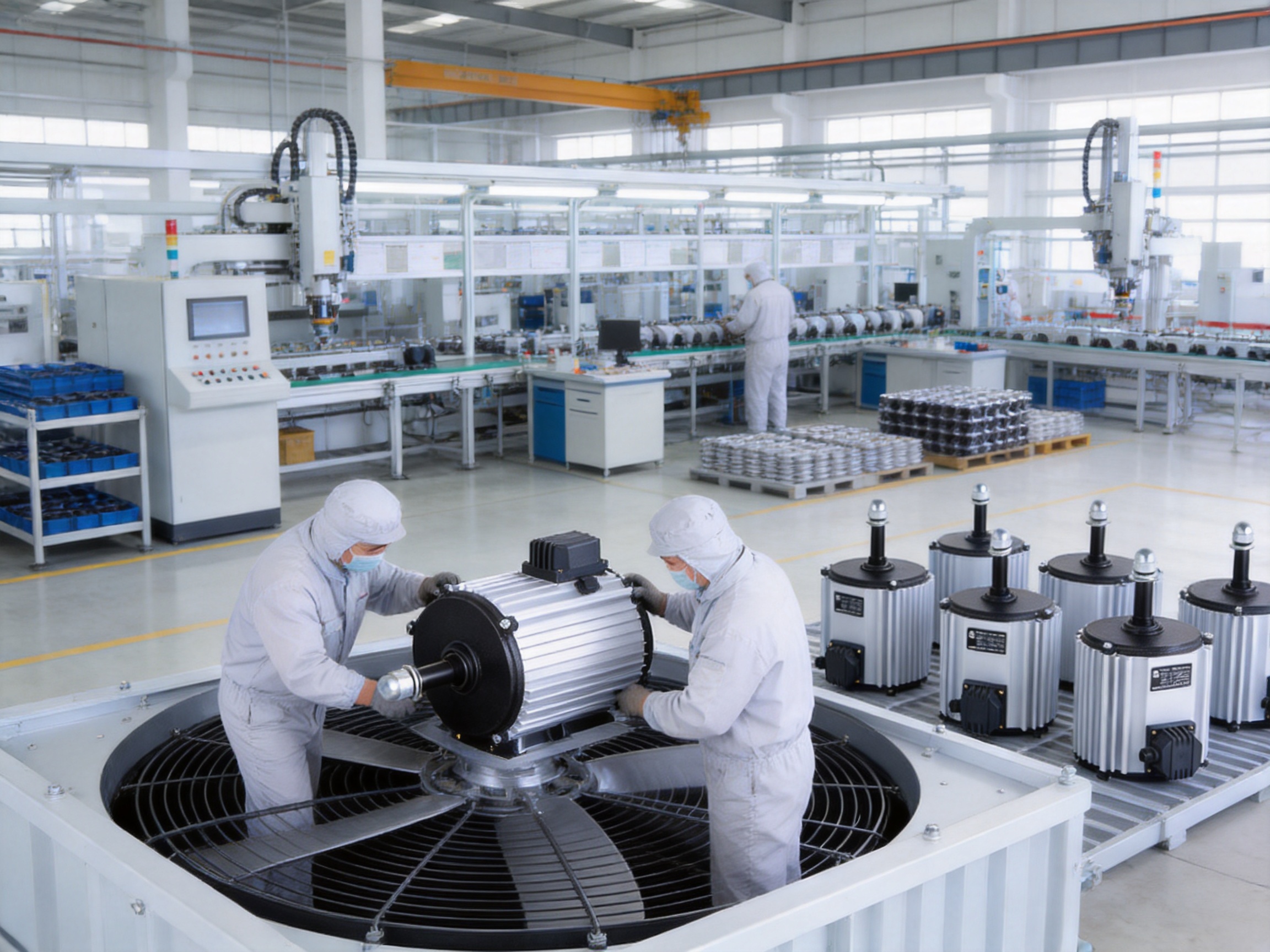
The company operates modern production facilities and uses advanced automated equipment. Automation can support consistent production by improving repeatability in processes such as component handling, winding-related operations, assembly, and inspection. In motor manufacturing, consistent process control is important because small variations in winding, alignment, or bearing installation can affect efficiency, noise, vibration, and service life.
Automated equipment does not replace engineering judgment or quality management. Instead, it provides a stable production foundation that can help reduce process variation. When combined with trained personnel and appropriate inspection procedures, automation supports the manufacture of products with repeatable dimensions and electrical characteristics.
5.3 Professional Research and Development
A professional research and development team enables the company to respond to different application requirements. Fan motors may need different voltage ratings, output levels, mounting structures, speed configurations, terminal arrangements, or environmental protections. R&D capability helps transform these requirements into practical motor designs.
For fiberglass fan applications, development work may involve the relationship between the housing material, internal heat dissipation, mechanical mounting, fan compatibility, and resistance to the intended environment. The product’s fiberglass casing reflects an application-oriented approach in which the motor is designed around the needs of a particular ventilation sector.
5.4 Quality Control Systems
The company emphasizes strict quality control systems. Quality control for motors normally covers incoming materials, process inspection, assembly verification, electrical testing, mechanical checks, and final product evaluation. The precise inspection plan may vary according to product type and customer requirements, but the objective is to identify defects before shipment and maintain stable product performance.
Important quality considerations for a motor of this type include winding continuity, insulation condition, terminal correctness, bearing seating, shaft alignment, rotor balance, housing integrity, mounting dimensions, and operating noise or vibration. Environmental suitability also depends on the quality of the fiberglass housing, seals, cable entry arrangements, and protective details.
5.5 Innovation and Technology Recognition
The manufacturer has been recognized as a provincial-level technology enterprise. This recognition supports the company’s positioning as a technology-oriented motor producer. For customers, technology capability is important because industrial motors are not simply interchangeable commodities. Product development, customization, process improvement, and application engineering can significantly affect the success of a ventilation project.
6. Manufacturing Process Considerations
Although the detailed internal production route for every motor is not provided, a professional motor manufacturing process generally consists of several controlled stages. Understanding these stages helps buyers evaluate why production capability matters and how quality is built into the final product.
6.1 Material Preparation
The process begins with the preparation and inspection of core materials, electrical components, conductors, insulation materials, bearings, shafts, fasteners, and housing components. For a fiberglass fan motor, the casing material must be appropriate for the intended environmental conditions and must meet dimensional requirements for assembly.
Material consistency is important. Variations in conductor quality can affect winding resistance and thermal performance. Inconsistent bearings can influence noise and service life. Dimensional variation in the housing or mounting components can create alignment problems when the motor is installed on a fan frame.
6.2 Stator and Winding Operations
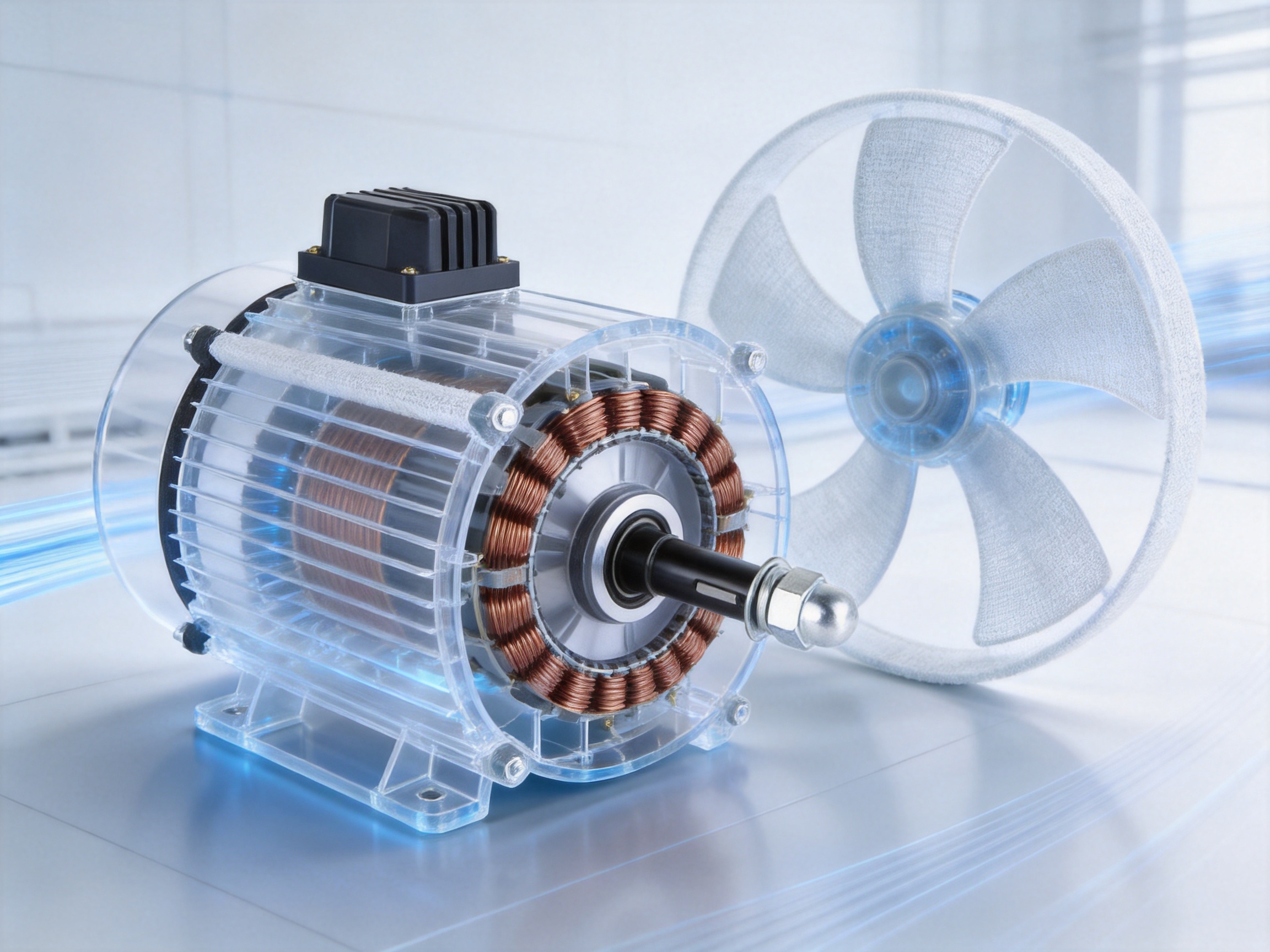
The stator winding forms the electromagnetic foundation of the motor. Conductors must be arranged correctly within the stator slots, insulated appropriately, and connected according to the required three-phase configuration. Winding quality affects current balance, starting behavior, temperature rise, efficiency, and reliability.
Controlled winding operations and process inspection help ensure that the three phases have consistent electrical characteristics. Proper insulation treatment is also important because the motor may be used in humid environments. Moisture, contamination, and mechanical damage can reduce insulation performance, so the production process must protect the winding system from these risks.
6.3 Rotor and Shaft Assembly
The rotor must be assembled with suitable dimensional accuracy and balance. An unbalanced rotor can produce vibration, increase bearing loads, create noise, and reduce the service life of the fan assembly. Shaft accuracy is also important because the shaft transfers motor torque to the fan or coupling system.
For a low-speed fan motor, smooth operation remains essential even when rotational speed is moderate. Vibration may loosen fasteners, damage fan components, and transmit noise into the building structure. Proper assembly and balancing procedures therefore contribute to both motor reliability and overall fan performance.
6.4 Housing Integration
The fiberglass housing must be integrated with the stator, rotor, bearings, terminal components, and mounting structure. The housing should provide stable support while protecting internal parts from the surrounding environment. Correct fit between the housing and internal components contributes to alignment, heat management, and mechanical strength.
Where the operating environment is humid or corrosive, attention to interfaces is especially important. Seams, covers, cable entries, fasteners, and mounting points must be considered as part of the complete protection system. A corrosion-resistant housing delivers the greatest value when the rest of the assembly is also carefully designed and installed.
6.5 Electrical and Functional Testing
Before shipment, motors should undergo suitable electrical and functional tests. These may include winding resistance checks, insulation tests, phase verification, no-load operation, direction checks, vibration assessment, and visual inspection. Testing helps identify wiring errors, abnormal noise, bearing problems, insulation weaknesses, and assembly issues.
For customers purchasing motors in quantity, documented inspection criteria can support incoming quality control and supplier evaluation. Buyers may request product drawings, rating information, inspection records, packaging specifications, and applicable test standards before placing a large order.
7. Applications Across Multiple Industries
7.1 Livestock and Poultry Buildings
Livestock and poultry facilities require dependable ventilation to control heat, humidity, odors, dust, and airborne gases. These buildings can be highly corrosive because of moisture, manure-related gases, cleaning agents, and chemical residues. Fiberglass fans and corrosion-resistant motors are therefore a practical combination.
The Y2-100-10 motor can be considered for ventilation systems that require a 380V three-phase supply and approximately 1100W of motor output. The final selection should be based on the fan manufacturer’s airflow and pressure requirements, the building size, the expected operating hours, and the environmental conditions.
7.2 Agricultural Greenhouses
Greenhouses use ventilation to regulate temperature, humidity, and air circulation. Irrigation systems, fertilizers, condensation, and high humidity can expose motor housings to moisture over long periods. A fiberglass motor can help reduce concerns about external rust and may be suitable for fans installed inside or near greenhouse structures.
Installers should still provide suitable drainage, cable protection, and electrical enclosures. The motor should not be positioned where it can be directly sprayed with water unless the complete assembly is rated for that condition.
7.3 Chemical and Fertilizer Facilities
Chemical and fertilizer environments may contain vapors or airborne particles that accelerate corrosion. Ventilation equipment in these facilities must be selected with careful attention to chemical compatibility, temperature, hazardous-area classification, and maintenance access.
The fiberglass housing provides an advantage in general corrosive environments, but purchasers must verify compatibility with the specific chemicals present. If the installation involves flammable gases, explosive dust, or hazardous classified areas, the motor must meet the applicable protection and certification requirements. The product should not be used in such areas without confirmed compliance.
7.4 Coastal and Salt-Laden Locations
Coastal air contains salt particles that can accelerate corrosion on exposed metal surfaces. Fans installed near the sea, fish-processing buildings, salt-storage areas, and marine-related facilities may benefit from fiberglass motor housings. The material’s resistance to rust can help preserve external condition and reduce maintenance compared with ordinary metal housings.
7.5 Industrial Workshops and Warehouses
Industrial workshops may need ventilation for heat removal, air exchange, welding fumes, dust, or process emissions. Warehouses may use large fans to improve worker comfort and prevent condensation. In these applications, the motor’s 380V three-phase rating and 1100W output can be suitable where the fan load is properly matched.
8. Installation Guidelines
Correct installation is essential to obtain the expected performance from any motor. Even a well-manufactured product can experience premature failure if it is incorrectly wired, poorly aligned, overloaded, or exposed to conditions outside its design range.
8.1 Confirm the Power Supply
Verify that the available supply is compatible with 380V, three-phase, 50Hz operation. Check the facility’s voltage stability and phase balance. A qualified electrician should complete all wiring work, install appropriate short-circuit protection, and confirm that the grounding system is effective.
8.2 Use Appropriate Motor Protection
A suitable motor protection device should be selected according to the motor’s rated current and the operating conditions. Overload protection helps reduce the risk of damage caused by excessive mechanical load, blocked fan blades, incorrect belt tension, or electrical abnormalities.
Where the fan operates in a dusty, humid, or corrosive area, the control cabinet and cable connections should also be protected. The motor’s environmental advantage cannot compensate for a poorly sealed terminal box, exposed wiring, or water entering through an unsuitable cable gland.
8.3 Check Mechanical Alignment
The motor must be mounted securely on a stable support. If the motor drives the fan through a direct shaft, the shaft alignment should be checked carefully. If belts or pulleys are used, pulley alignment and belt tension must be set according to the fan manufacturer’s instructions.
Misalignment can increase vibration and bearing loads. Excessive belt tension can overload bearings, while insufficient tension can cause slipping and heat generation. Fasteners should be tightened correctly, and the entire fan assembly should be inspected for movement during initial operation.
8.4 Verify Rotation Direction
After wiring, briefly operate the motor and confirm that the rotation direction matches the fan design. Incorrect rotation can significantly reduce airflow and may create abnormal mechanical loading. If the direction is wrong, the electrical connection should be corrected by a qualified technician after isolating the power supply.
8.5 Protect Against Water and Direct Spray
Fiberglass provides good resistance to moisture-related corrosion, but the motor should not be treated as waterproof unless its complete protection rating confirms that capability. Install the motor where water can drain away, avoid direct spray, and use suitable covers or shields when required.
9. Maintenance and Service Practices
Regular maintenance helps preserve motor performance and reduces the likelihood of unexpected downtime. The required service frequency depends on operating hours, load, dust levels, humidity, chemical exposure, and installation accessibility.
9.1 Visual Inspection
Inspect the housing, mounting points, cable entries, terminals, fan guard, and surrounding structure. Look for cracks, loose hardware, contamination, unusual discoloration, moisture accumulation, and signs of mechanical movement. Although fiberglass resists rust, nearby metal components may still corrode and should be checked.
9.2 Cleaning
Dust and debris can accumulate around the fan and motor assembly. Excessive contamination may interfere with heat dissipation or create an imbalance in the fan. Clean the equipment using methods appropriate for the housing and the site. Avoid damaging the fiberglass surface, electrical connections, seals, or labels.
9.3 Bearing and Vibration Checks
Abnormal noise or vibration may indicate bearing wear, rotor imbalance, misalignment, loose fasteners, damaged fan blades, or belt problems. Early detection allows the maintenance team to correct the cause before it develops into a more serious failure.
Because the motor may be connected directly to a fan, vibration should be evaluated across the complete assembly rather than at the motor alone. A damaged fan blade or weak support frame can create vibration that is incorrectly attributed to the motor.
9.4 Electrical Inspection
Periodic electrical inspection can identify loose terminals, insulation deterioration, phase imbalance, and abnormal current draw. Measurements should be taken by qualified personnel using suitable instruments and following safe isolation procedures.
If operating current is consistently higher than expected, investigate the fan load, supply voltage, bearing condition, airflow resistance, and control equipment. Continuing to operate an overloaded motor can result in excessive heating and reduced service life.
10. How to Select the Correct Motor for a Fiberglass Fan
The Y2-100-10 motor is not automatically suitable for every fiberglass fan. Buyers should evaluate the complete system before ordering.
10.1 Match Rated Power
Confirm that the fan’s required shaft power does not exceed the motor’s 1100W rating. Consider continuous operation, starting conditions, air pressure, duct resistance, and seasonal changes. A motor that is too small may overheat, while a motor that is unnecessarily large may increase purchase and operating costs.
10.2 Match Voltage and Frequency
The site must provide a compatible 380V, three-phase, 50Hz power supply. If the project uses another voltage or frequency, consult the supplier about an alternative motor configuration rather than assuming that a standard connection will be acceptable.
10.3 Match Speed and Fan Design
The 10-pole configuration provides a lower-speed operating profile than many common four-pole or two-pole motors. Confirm that the fan’s blade design and airflow target are compatible with this speed. The correct combination can deliver smooth ventilation, while an incorrect combination may produce insufficient airflow or overload the motor.
10.4 Consider the Environment
Review humidity, temperature, salt exposure, chemical vapors, dust, cleaning procedures, and installation location. Fiberglass is advantageous in many corrosive environments, but the complete product specification must be checked for the intended site. If special certifications are required, request confirmation before purchase.
10.5 Confirm Mechanical Dimensions
Before ordering, compare mounting dimensions, shaft dimensions, shaft extension, terminal position, and fan interface requirements. Mechanical compatibility prevents delays during installation and reduces the need for field modifications.
11. Purchasing Advantages for Distributors and OEM Customers
Distributors and original equipment manufacturers often need more than a single motor specification. They require stable supply, consistent quality, technical communication, packaging reliability, and the ability to support different market requirements.
Shengzhou Jiangxin Motor Technology Co., Ltd. serves international customers and reports that its products are exported to more than 60 countries and regions. International market experience can support communication regarding specifications, documentation, packaging, shipping arrangements, and regional application needs.
The company’s product portfolio includes standard and customized motor products. This is useful for customers who need variations in voltage, power, mounting, shaft design, housing, speed, wiring, or application configuration. A manufacturer with experience in customized AC/DC motors may be able to support product adaptation more efficiently than a supplier focused on only one fixed model.
For OEM projects, buyers should provide detailed technical information, including fan drawings, electrical requirements, target airflow, duty cycle, installation environment, expected annual quantity, packaging needs, and applicable standards. Clear technical communication at the quotation stage can reduce misunderstandings and improve the final product match.
12. Energy, Reliability, and Total Cost Considerations
Motor price is only one part of the total cost of a ventilation system. Energy consumption, maintenance labor, replacement frequency, downtime, installation effort, and corrosion-related repairs can have a greater financial effect over the equipment’s service life.
A motor that is appropriately sized for the fan can operate more effectively than one that is overloaded or poorly matched. The 1100W rating should therefore be evaluated together with the fan’s airflow and pressure requirements. Avoiding unnecessary oversizing can help control energy use, while avoiding undersizing can reduce overheating and premature replacement.
The fiberglass housing may also contribute to lower lifecycle maintenance in corrosive sites. Reduced rust-related repair, easier handling, and better compatibility with fiberglass fan equipment can create practical savings. The actual benefit will depend on the site, maintenance program, operating hours, and comparison product.
Reliability is particularly important in ventilation applications because a failed fan may affect an entire production process. In agricultural buildings, inadequate airflow can cause heat stress and humidity problems. In industrial facilities, insufficient ventilation can affect working conditions and process control. Selecting a motor designed for the environment is therefore a risk-management decision as well as a technical one.
13. Quality and Reliability Strengths of the Manufacturer
The manufacturer’s strengths are based on several connected capabilities: focused motor production, product development, modern production facilities, automated equipment, quality control, and experience serving international markets.
Its location in Shengzhou, Zhejiang Province, provides access to the broader industrial resources of the Yangtze River Delta. This region has a strong manufacturing base and established supply chains for mechanical, electrical, and industrial products. A favorable industrial location can support material sourcing, production coordination, logistics, and technical collaboration.
The company emphasizes reliable, energy-efficient, and long-lasting motor products. These objectives are consistent with the needs of industrial ventilation customers, who generally value stable operation, manageable maintenance, and predictable service life. The company’s focus on AC/DC motors also gives it a broad technical foundation for developing products for air cooling, industrial heating, hydraulic systems, environmental equipment, and other applications.
Customer-oriented service is another important strength. Motor selection often involves technical questions that cannot be answered by a catalog title alone. Voltage, power, speed, environmental resistance, mounting, fan compatibility, and operating duty must be reviewed together. A supplier that can communicate clearly and provide application support can help customers avoid incorrect purchases.
14. Recommended Use Cases and Limitations
The Y2-100-10 380V 1100W Fiber Glass Fan Motor is especially appropriate for fiberglass fan applications in humid, corrosive, agricultural, chemical, and coastal environments. It is a strong candidate where rust resistance, lower handling weight, three-phase operation, and a steady low-speed drive are important.
However, responsible selection requires recognition of its limitations. The motor must be operated within its voltage, frequency, power, temperature, and environmental requirements. The housing’s corrosion resistance does not guarantee compatibility with every chemical. The motor should not be installed in a hazardous classified location unless the required certification is confirmed. It should not be overloaded to compensate for an incorrectly selected fan.
Users should also confirm whether the motor is intended for direct drive, belt drive, or another mechanical arrangement. The fan system must be designed to prevent excessive shaft loads, vibration, water exposure, and blocked airflow. When these considerations are addressed, the product can serve as a dependable drive component for a wide range of ventilation systems.
15. Frequently Asked Questions
Q1: What type of motor is the Y2-100-10?
It is a three-phase asynchronous motor designed for fiberglass fan applications. It is rated at 380V and 1100W and uses a 10-pole configuration.
Q2: What environments are suitable for this motor?
The fiberglass housing makes it suitable for many humid, corrosive, acidic, alkaline, agricultural, chemical, and coastal environments. The exact suitability depends on the site’s chemicals, temperature, moisture level, installation method, and required protection rating.
Q3: Why choose fiberglass instead of cast iron?
Fiberglass does not rust like conventional steel or cast iron and is generally lighter. These characteristics can reduce external corrosion concerns and make transportation and installation easier, especially in difficult-access locations.
Q4: Is the motor suitable for every fiberglass fan?
No. The fan’s required power, speed, voltage, frequency, mounting dimensions, shaft arrangement, load, and operating duty must be matched with the motor. The 1100W output and 10-pole configuration should be checked against the fan manufacturer’s technical requirements.
Q5: What does the 10-pole design indicate?
The number of poles influences the motor’s synchronous speed. At 50Hz, a 10-pole motor has a theoretical synchronous speed of approximately 600 revolutions per minute, while the actual asynchronous operating speed is lower because of slip. The final speed should be confirmed from the complete motor specification.
Q6: Can the motor operate on a single-phase supply?
The product is specified as a 380V three-phase motor. It should not be connected to a single-phase supply unless a suitable approved system and manufacturer-supported configuration are provided.
Q7: Does fiberglass make the motor waterproof?
No. Fiberglass improves resistance to rust and many environmental contaminants, but it does not automatically make the complete motor waterproof. The installation must prevent direct water spray, immersion, and moisture entry through cables, terminals, or openings unless the product’s protection rating specifically allows those conditions.
Q8: What protection should be used during installation?
The motor should be connected through suitable overload and short-circuit protection, with effective grounding and correctly sized cables. A qualified electrician should complete the wiring and verify phase balance, connection correctness, and rotation direction.
Q9: What industries can use this product?
Potential applications include livestock and poultry ventilation, greenhouses, agricultural buildings, fertilizer facilities, chemical workshops, coastal installations, warehouses, industrial workshops, and other locations using compatible fiberglass fans.
Q10: What manufacturing strengths support this motor?
The manufacturer focuses on AC/DC motor development and production, operates modern facilities with automated equipment, maintains a professional R&D team, applies quality control systems, and serves customers in more than 60 countries and regions.
Q11: Can customized versions be requested?
The manufacturer produces customized motors as part of its broader product capability. Customers should provide detailed requirements such as voltage, power, speed, mounting dimensions, shaft configuration, wiring, housing needs, operating environment, and expected quantity for evaluation.
Q12: What should be checked before placing an order?
Confirm the electrical rating, frequency, pole number, motor output, fan load, mounting dimensions, shaft details, environmental conditions, required certifications, packaging, delivery schedule, and available technical documentation. This information helps ensure that the selected motor is suitable for the complete ventilation system.
16. Conclusion
The Y2-100-10 380V 1100W Fiber Glass Fan Motor is a specialized solution for fiberglass fan and industrial ventilation applications. Its three-phase asynchronous design provides a practical foundation for reliable operation, while the 380V supply, 1100W power rating, and 10-pole configuration are suited to selected medium-duty fan systems requiring stable, relatively low-speed drive performance.
Its most significant advantage is the fiberglass casing. The housing offers strong resistance to rust and good suitability for humid, acidic, alkaline, agricultural, chemical, and coastal environments. Compared with conventional cast-iron or steel motor housings, it can also reduce handling weight and simplify installation in difficult locations.
The product is supported by a manufacturer focused on AC/DC motors, micro motors, customized solutions, research and development, automated production, and quality control. The company’s international export experience and broad product portfolio provide additional value for distributors, OEM customers, contractors, and industrial users.
For the best results, the motor should be selected as part of a complete fan system. Electrical supply, airflow requirements, static pressure, speed, mechanical dimensions, environmental exposure, protection equipment, installation quality, and maintenance practices must all be considered. When correctly matched and properly installed, the Y2-100-10 motor can provide a durable and practical drive solution for ventilation equipment operating in demanding environments.
References
1. Product specification information for the Y2-100-10 380V 1100W Fiber Glass Fan Motor.
2. Manufacturer-provided company profile and product range information for Shengzhou Jiangxin Motor Technology Co., Ltd.
3. General principles of three-phase asynchronous motor operation and pole-number relationships.
4. General industrial motor installation, grounding, overload protection, and maintenance practices.
5. General engineering considerations for fiberglass materials in humid and corrosive environments.
Product: Y2-100-10 380V 1100W Fiber Glass Fan Motor
 Ready To Customise
 Your Motor Products?

We are professional motor manufacturers, delivering powerful, stable, and efficient power cores for all industries through precision craftsmanship and innovation.
Contact Us
-
 Mobile:+86 13575536911
-
 Tel:+86 18357538240
-
 Whatsapp:+8618357538240
-
 Email:betty@dbjxmotor.com
-
 Company Address
Copyright © by Shengzhou Jiangxin Motor Technology Co., Ltd. All Rights Reserved.
Wholesale Industrial Fan Motors Manufacturers
